Lazy Dog: A Handwritten Font with Warmth and Whimsy
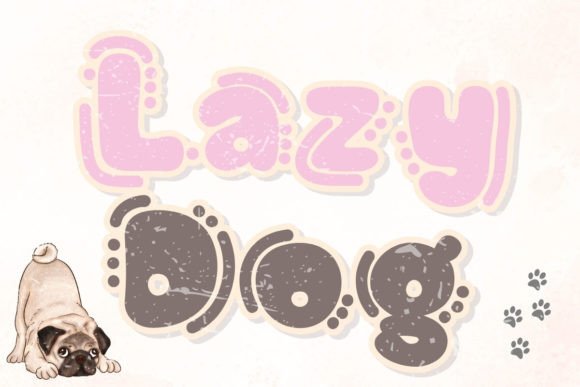
Lazy Dog isn’t just another playful script font—it’s a carefully crafted typeface that balances personality with practicality. Designed to evoke the gentle, unhurried charm of a dog lounging in sunlit grass, it avoids cartoonish exaggeration while retaining unmistakable character. Unlike many handwritten fonts that rely on excessive swashes or inconsistent spacing to appear “authentic,” Lazy Dog achieves its voice through subtle, intentional design choices: relaxed stroke endings, soft contrast between thick and thin segments, and a natural rhythm across letterforms. It’s the kind of typeface you notice not for how flashy it is, but for how comfortably it fits—like a well-worn sweater or a familiar voice in a crowded room.
What Sets Lazy Dog Apart From Other Handwritten Fonts
Many script fonts fall into one of two traps: either they’re too rigid and mechanical, lacking organic flow, or too irregular to use reliably at scale. Lazy Dog sidesteps both by prioritizing consistency without sacrificing expressiveness. Each glyph maintains a cohesive baseline, x-height, and spacing profile—critical for legibility in longer text blocks or interface elements. The curves are generous but controlled; the terminals taper gently rather than flicking unpredictably. There’s no forced “shakiness” or artificial jitter meant to simulate hand-drawn imperfection. Instead, the warmth comes from proportion, timing, and weight distribution—qualities that translate well across sizes and mediums.
This approach makes Lazy Dog unusually versatile for a display-oriented handwritten font. It works effectively at 24pt in a blog header, holds up at 16pt in a callout box, and even reads clearly at 14pt in short captions—something few casual scripts manage without visual strain. Its OpenType features include standard ligatures and contextual alternates, which subtly refine connections between letters like “f” and “i” or “c” and “t.” These aren’t decorative flourishes; they’re functional refinements that support natural reading flow.
Real-World Use Cases and Practical Performance
In practice, Lazy Dog shines where tone matters as much as information. A small-batch bakery might use it for seasonal menu boards or packaging labels—not because it shouts “look at me,” but because it quietly reinforces values like craft, care, and approachability. An educator creating printable classroom resources can apply Lazy Dog to headings or activity titles without worrying about overwhelming young readers or clashing with supporting sans-serif body text. Freelance designers building brand identities for wellness coaches, indie bookshops, or handmade goods brands often reach for Lazy Dog when they need a friendly yet professional anchor for logotypes or social media graphics.
It performs especially well in digital contexts where personality must coexist with usability. On websites, Lazy Dog functions best as a primary display font—paired with a clean, neutral sans-serif (like Inter, Lato, or Work Sans) for body copy. Its lowercase “a,” “g,” and “s” retain distinct shapes without ambiguity, reducing cognitive load. In email newsletters or PDF reports, it adds visual interest to section dividers or pull quotes without undermining scannability. One limitation worth noting: Lazy Dog doesn’t include extended language support beyond basic Latin characters (no Cyrillic, Greek, or Vietnamese diacritics), so it’s best suited for English-first projects or bilingual layouts where only headlines require stylization.
Quality, Reliability, and Long-Term Value
The font files are well-structured, with robust hinting for screen rendering and smooth vector outlines for print. Tested across modern browsers and design tools—including Figma, Adobe Creative Cloud, and Affinity Suite—Lazy Dog loads quickly and renders consistently. Kerning pairs have been thoughtfully adjusted, particularly around common combinations like “To,” “The,” and “and,” minimizing awkward gaps that can disrupt rhythm. There’s no noticeable distortion when scaling or exporting to SVG, and variable weight options aren’t available—but the single weight (Medium) is intentionally tuned to sit confidently between light and bold, avoiding the fragility of ultra-thin scripts or the heaviness of over-emphasized alternatives.
From a long-term perspective, Lazy Dog avoids trend dependency. It doesn’t lean into current typographic fads—no exaggerated contrast, no distorted proportions, no ironic detachment. That gives it staying power: a logo set in Lazy Dog today won’t feel dated in three years, and a brochure designed with it won’t require rebranding simply because stylistic preferences shift. Its value lies less in novelty and more in quiet reliability—a tool that supports intent rather than competing with it.
Who Benefits Most—and When to Reach For It
Professionals who regularly balance aesthetic goals with functional requirements will find Lazy Dog most useful. Think marketers crafting campaign assets for lifestyle brands, educators developing inclusive learning materials, or small business owners designing their own signage and social content. It’s also well-suited for creators producing digital products—like Notion templates, Canva kits, or printable planners—where warmth and clarity must coexist. Bloggers writing about parenting, sustainability, or creative hobbies may use it to soften headlines without undermining credibility.
That said, Lazy Dog isn’t ideal for every scenario. It shouldn’t be used for legal disclaimers, technical documentation, data-heavy dashboards, or any context demanding maximum neutrality or high-speed scanning. It’s also not a replacement for system UI fonts in interactive elements like buttons or form fields. But within its intended scope—invitations, branding accents, editorial highlights, product packaging, and illustrated web components—it delivers measurable impact: increasing perceived friendliness, reinforcing brand voice, and guiding attention without shouting.
Making It Work in Your Workflow
Start simple. Apply Lazy Dog to one high-impact element—like a hero headline or logo lockup—and pair it deliberately. Avoid stacking multiple decorative fonts; let Lazy Dog carry the expressive weight while supporting typefaces handle utility. If using it in CSS, define fallbacks thoughtfully: font-family: "Lazy Dog", "Segoe UI", system-ui, sans-serif; ensures graceful degradation. In design software, enable optical kerning and test line breaks manually—some letter combinations (e.g., “w” followed by “a”) benefit from slight manual adjustment at larger sizes.
Also consider licensing. Lazy Dog is typically offered under a commercial-use license, covering digital and print applications for individuals and teams. Always verify permissions for redistribution—such as embedding in client deliverables or SaaS platforms—as usage rights vary by vendor. And if you're evaluating alternatives, compare not just appearance but technical execution: check spacing metrics, test real copy (not just “The quick brown fox”), and preview on actual devices your audience uses.
Ultimately, Lazy Dog earns its place not by trying to do everything, but by doing one thing exceptionally well: offering warmth without weakness, playfulness without pretense, and personality without compromise. It’s a font that understands its role—not as the center of attention, but as the quiet, steady presence that makes other elements feel more human.