Interaction: A Handwritten Font with Quiet Confidence
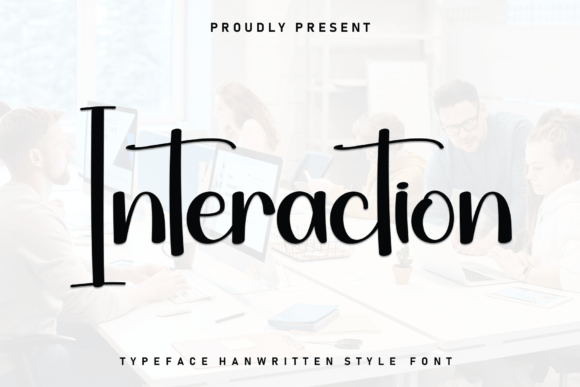
If you’ve ever scrolled past a wedding invitation, boutique packaging, or an artisanal coffee bag and paused—just for a second—because the lettering felt *alive*, you’ve likely encountered the quiet magic of a thoughtful handwritten font. Interaction is exactly that kind of typeface: not flashy, not overly ornate, but deeply considered. It’s a premium font built on rhythm, warmth, and subtle variation—each character carries a gentle lift, a soft taper, a confident curve. There are no sharp edges or mechanical repetitions here. Instead, Interaction offers a consistent yet organic flow, like ink settling naturally onto paper.
More Than Just “Handwritten”—It’s Thoughtfully Human
Calling Interaction a “handwritten font” is accurate—but incomplete. Many script fonts lean into exaggerated flourishes or chaotic energy. Interaction avoids both traps. Its lowercase ‘a’, ‘g’, and ‘y’ have open, friendly counters. Uppercase letters maintain presence without shouting—notice how the capital ‘S’ balances weight and grace, or how the ‘R’ anchors itself with a grounded, unhurried leg. The spacing between letters (kerning) feels intuitive, never cramped or awkward. That’s intentional design, not algorithmic mimicry.
This isn’t a font for every line of body text. It’s a display font—meant to lead, to invite, to resonate. Think of it as the voice you’d choose to introduce your brand’s story, not recite its terms and conditions. Its elegance comes from restraint: minimal contrast between thick and thin strokes, even color when set at size, and a natural baseline that breathes rather than bounces.
Where Interaction Earns Its Place
You’ll find Interaction thriving where authenticity and intention matter most. In editorial design, it elevates magazine mastheads, chapter openers, or pull quotes—adding texture without competing with strong photography or illustration. For brand identity, it works beautifully in logo design for studios, wellness practices, ceramicists, independent publishers, or small-batch food brands. Its warmth signals approachability; its polish signals care.
In packaging design, Interaction shines on labels, boxes, and tags—especially when printed on textured stock. The font’s slight irregularity mirrors handmade paper or linen wraps, reinforcing craft over mass production. On social media graphics, it adds distinction to Instagram story headers or Pinterest quote cards—cutting through visual noise without relying on trends.
It also performs well in web design when used sparingly: hero section headlines, CTA buttons with short copy (“Join Us”, “Learn More”), or testimonial highlights. Just avoid long paragraphs or tiny sizes—it’s not a web-safe sans serif, and shouldn’t be asked to behave like one.
What Interaction Communicates—Without Saying a Word
Typography shapes perception faster than most realize. Interaction subtly tells your audience: This was made with attention. This values craft over convenience. This understands nuance. That impression strengthens brand consistency across touchpoints—whether someone sees your logo on a business card, your newsletter header, or your booth banner at a local market.
Readability remains high *within its intended use*. At 24–48pt, it’s clear and inviting. At 14pt in a tight line-height? Not ideal—and that’s okay. Its strength lies in emphasis, not endurance. When paired thoughtfully (more on that below), Interaction helps establish visual hierarchy: guiding the eye first to what matters most, then supporting it with quieter, more functional type.
Practical Tips Before You Use It
Test before you commit. Download a trial and set real copy—not lorem ipsum. Try your actual tagline, product name, or event title. Does it feel right at the size and weight you need? Does it hold up next to your primary brand colors?
Check what’s included. Most versions of Interaction offer at least regular and bold weights, sometimes with alternate characters or ligatures. Look for OpenType features like contextual alternates—they add natural variation when enabled in design software (Illustrator, InDesign, Figma). These small details prevent repetition fatigue in longer words like “beautiful” or “community.”
Pair it wisely. Interaction pairs best with clean, neutral companions: a warm sans serif (like Poppins or Lato) for body text, or a quiet serif (such as Merriweather or Cormorant Garamond) for editorial balance. Avoid other scripts or highly decorative fonts—they’ll compete, not complement. One pairing rule of thumb: if your secondary font has personality, let Interaction lead; if your secondary font is utilitarian, let Interaction breathe.
Licensing matters—especially commercially. Interaction is a commercial font. If you’re using it in client work, on a Shopify store, or in a paid newsletter template, confirm the license covers your use case. Most foundries offer desktop, web, and app licenses separately—don’t assume one covers all. Small business owners and solopreneurs should double-check whether the license permits unlimited projects or requires per-client purchase.
A Few Real Moments Where Interaction Fits Naturally
- A local florist uses Interaction for their seasonal workshop title (“Spring Arranging Workshop”) alongside a light, airy sans serif for date/location details.
- An indie publisher sets the cover title of a memoir in Interaction—then uses a classic serif for the author name and blurbs, letting the font’s humanity echo the book’s tone.
- A ceramic studio prints Interaction on recycled kraft tags tied to mugs and bowls—its soft curves mirroring the tactile quality of the glaze.
- A therapist’s website uses Interaction only in the headline of their “About” section—creating an immediate sense of calm and personal connection before visitors read a single sentence.
None of these uses force the font into roles it wasn’t designed for. They respect its nature—and in return, Interaction brings quiet distinction. It doesn’t solve every design problem. But when you need warmth that feels earned, elegance that feels honest, and handwriting that feels like it belongs—not just to a trend, but to your work—that’s when Interaction steps in, confidently, and does its job beautifully.