Barbie Birthday: A Handwritten Font with Timeless Grace
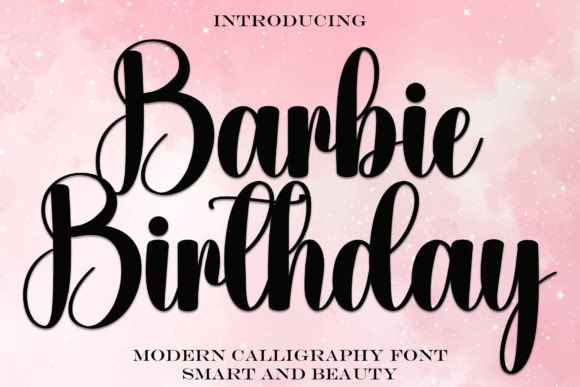
Barbie Birthday isn’t just another script font—it’s a thoughtful fusion of classic calligraphic discipline and modern design sensibility. Designed with deliberate rhythm, balanced weight distribution, and subtle flourishes, it carries the warmth of hand-drawn lettering without sacrificing legibility or versatility. Its curves are confident but never exaggerated; its spacing is generous but never loose. That balance makes Barbie Birthday especially useful when you need elegance to feel intentional—not decorative.
Why Designers Reach for Barbie Birthday
Unlike many trendy handwritten fonts that lean heavily into whimsy or irregularity, Barbie Birthday maintains structural integrity. Each character has clear entry and exit strokes, consistent x-height, and refined terminals—traits rooted in traditional copperplate and Spencerian models. That foundation means it scales well across sizes and mediums: from a small product tag to a full-page magazine spread.
It works where other scripts fail—not because it’s “safe,” but because it’s considered. Pair it with a clean sans-serif like Inter or Poppins for contrast that feels purposeful, not accidental. Use it for headlines, short quotes, packaging accents, or invitation suites where tone matters as much as typography.
Creative Applications Across Real Projects
Barbie Birthday shines brightest when it supports human-centered goals—not just aesthetic ones. Here’s how different creators use it meaningfully:
- Small business owners apply it to custom gift tags, seasonal email headers, and boutique storefront signage—especially for brands centered on celebration, self-expression, or personal milestones (e.g., baby announcements, anniversary cards, artisanal candle labels).
- Educators and course creators integrate it into slide decks and workbook covers to soften academic tone without undermining credibility—think workshop titles like “Your First Creative Business Plan” or “Mindful Marketing for Coaches.”
- Bloggers and content marketers use it selectively: as a pull-quote font in long-form posts about intentionality, branding, or creative confidence—not as body text, but as punctuation that invites pause and reflection.
- Freelance designers build brand systems around it by pairing it with neutral typefaces and restrained color palettes—ensuring the font enhances voice rather than dominates it.
One designer recently used Barbie Birthday for a local florist’s rebrand: not on every sign or receipt, but only on handwritten-style thank-you cards tucked into bouquets and on the “Seasonal Arrangements” section header of their website. The result? A quiet signal of care—felt more than read.
Staying Clear, Consistent, and Audience-Aware
Handwritten fonts carry strong tonal associations—and Barbie Birthday leans toward warmth, refinement, and approachable sophistication. That makes it less ideal for high-energy tech startups or gritty streetwear lines, but excellent for wellness studios, independent bookshops, wedding planners, or handmade skincare brands.
To keep usage effective:
- Limit scope. Use Barbie Birthday for one primary function per project—e.g., headlines only, or logo lockups only. Avoid layering multiple script fonts or overloading it with effects (drop shadows, gradients, heavy outlines).
- Test readability early. At 16px on screen or 8pt in print, does “&” still read clearly? Does lowercase “a” distinguish itself from “o”? Barbie Birthday performs well—but always verify in your actual layout context.
- Respect hierarchy. If your audience skims first, let Barbie Birthday guide attention—not compete for it. Place it where users naturally pause: opening lines, section dividers, CTA buttons with minimal copy (“Yes, I’m In”).
Variations, Stylistic Choices, and Subtle Shifts
Barbie Birthday includes standard OpenType features—ligatures, alternate characters, and contextual swashes—that let you adjust formality and flow without switching fonts. Turn on discretionary ligatures for invitations (“To” + “you” becomes a graceful connected pair). Swap in a more upright “t” or simplified “g” for cleaner digital interfaces.
You can also shift perception through pairing and scale:
- For playful elegance: set Barbie Birthday at 28px with 1.4 line height, paired with a rounded sans-serif (like Quicksand) in captions.
- For quiet authority: use it in all caps at 20px with tight tracking and a serif like Merriweather for supporting text—ideal for editorial mastheads or podcast cover art.
- For tactile authenticity: print it on textured paper with slight ink bleed simulation (in design software), then photograph it alongside real objects—dried lavender, linen napkins, ceramic mugs—to ground digital work in physical warmth.
Getting Started Without Overcomplicating
If you’re new to working with expressive type, start small. Download Barbie Birthday and open a blank document. Type three words that reflect your current project’s core feeling—e.g., “calm,” “crafted,” “together.” Adjust size, spacing, and weight until the phrase feels aligned—not just pretty, but true.
Then ask: Does this support what the viewer needs to know—or just what I want them to feel? If it’s the latter, simplify. If it’s the former, you’re on solid ground.
No font replaces strategy—but Barbie Birthday gives thoughtful creators a reliable tool to express care, clarity, and quiet confidence. It doesn’t shout. It settles in. And in a landscape crowded with visual noise, that kind of presence is rare—and valuable.
Use it where intention matters most: on the things people keep, share, or return to. Not as decoration—but as quiet reinforcement of what’s already meaningful.