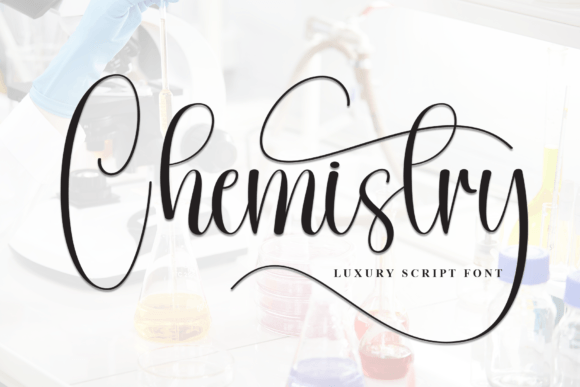
Chemistry: A Handwritten Font with Elegant Charm
Chemistry isn’t just about reactions and compounds—it’s a beautifully crafted handwritten font designed for creators who value both personality and polish. With smooth, confident strokes and subtle flourishes, Chemistry balances approachability and sophistication. It’s not overly ornate, yet never plain; it feels human-made, not algorithmically generated. That authenticity is why designers, educators, and small business owners reach for Chemistry when they want text to feel intentional—not just readable, but resonant.
What Makes Chemistry Stand Out
Unlike many script fonts that sacrifice legibility for flair, Chemistry maintains clarity at medium sizes—especially in headings, quotes, and short-form text. Its lowercase ‘g’, ‘y’, and ‘s’ include gentle terminals that guide the eye without distraction. The uppercase letters carry presence without dominance, making them ideal for logos or featured headlines. Spacing is thoughtfully open, reducing visual clutter in tight layouts like Instagram story text or product packaging.
It’s also versatile by design: pair Chemistry with a clean sans-serif (like Inter or Montserrat) for contrast that feels balanced, not jarring. That pairing works equally well on a workshop flyer, a teacher’s classroom poster, or a boutique’s email header. No extra ligatures or stylistic sets are needed—Chemistry delivers consistent charm straight from the .ttf file.
Creative Uses Across Real Projects
Here’s where Chemistry shines—not as decoration, but as functional expression:
- Instagram & Social Content: Use Chemistry for quote graphics, event announcements, or brand voice snippets. Try setting a short line like “Your next idea starts here” in Chemistry over a muted background—it draws attention without competing with imagery.
- Educational Materials: Science teachers use Chemistry to label diagrams, highlight vocabulary (“catalyst”, “equilibrium”), or title lab handouts. Its warmth softens technical content, helping students connect emotionally before diving into complexity.
- DIY & Craft Projects: Vinyl cutters and Cricut users report excellent results with Chemistry at sizes 48pt and up. It holds detail in paper cutouts, embroidery patterns, and hand-lettered greeting cards—especially when printed on textured cardstock.
- Small Business Branding: A local apothecary, ceramic studio, or indie bakery might use Chemistry for their logo lockup or menu headers. It signals care and craftsmanship—qualities customers associate with handmade goods and personal service.
How Different Creators Adapt Chemistry
Freelancers often use Chemistry to differentiate proposals and pitch decks—adding a signature touch to section titles or client testimonials. One graphic designer told us she uses it only for her “why” statement on the first slide, then switches to a neutral font for bullet points. That restraint makes the handwritten element feel deliberate, not decorative.
Bloggers and newsletter writers apply Chemistry selectively: as a pull-quote font within long-form articles, or for recurring series titles (“This Week’s Experiment”, “Reader Notes”). That repetition builds recognition without overwhelming readers. Educators print Chemistry-based flashcards for vocabulary review—the slight variation in stroke weight helps visual memory without introducing confusion.
For marketers running limited-time offers, Chemistry adds urgency *and* warmth. Compare “Sale ends Friday!” in Helvetica versus Chemistry: same message, different emotional texture. The latter feels personal, like a note from someone who knows your audience—not a broadcast.
Keeping It Clear and Audience-Friendly
Legibility matters most when attention is split—like on mobile feeds or classroom walls. To keep Chemistry effective:
- Size wisely: Use 36pt minimum for body text in print; 48pt+ for digital displays viewed at arm’s length. Avoid using it below 24pt except for large-format signage where viewers are farther away.
- Limit line length: Keep paragraphs set in Chemistry to under 40 characters per line. Longer lines strain readability in scripts—even elegant ones.
- Contrast is key: Always test Chemistry against its background. It performs best on solid light or dark tones—not busy photos or low-contrast gradients. If overlaying on images, add a subtle semi-transparent backdrop behind the text.
- Stay consistent: Pick one role for Chemistry in a project (e.g., “headings only”) and stick to it. Mixing it with other scripts dilutes its impact and risks visual noise.
Realistic Inspiration—Not Just Ideals
You don’t need a full rebrand to start using Chemistry meaningfully. Try these low-lift ideas:
- Add it to your Canva template library and use it for the “featured resource” banner on your blog sidebar.
- Replace the default font in your Google Slides presentation title slides—keep all other text in your standard font.
- Use it for the “thank you” line in your email sign-off. Just one line—no redesign required.
- Print a Chemistry-set affirmation (“You’ve got this”) on a 5×7 card and pin it where you’ll see it daily.
These aren’t trends—they’re tools. Chemistry works because it supports intention, not replaces it. When you choose it, you’re not choosing “a pretty font.” You’re choosing to signal care in execution, to honor the person reading, and to make space for humanity in design choices that too often default to speed or scale.
A Word on Authenticity and Use
Like any expressive tool, Chemistry gains power through thoughtful application—not volume. Overuse flattens its effect. Underuse leaves potential untapped. The sweet spot lies in moments where tone matters as much as information: welcoming a new subscriber, framing student feedback, introducing a product born from real trial and error.
If you’re evaluating fonts for an upcoming project, ask: “Does this help my audience feel seen—or just informed?” Chemistry answers that question with quiet confidence. It doesn’t shout. It invites. And in a world saturated with synthetic perfection, that invitation is increasingly rare—and increasingly valuable.