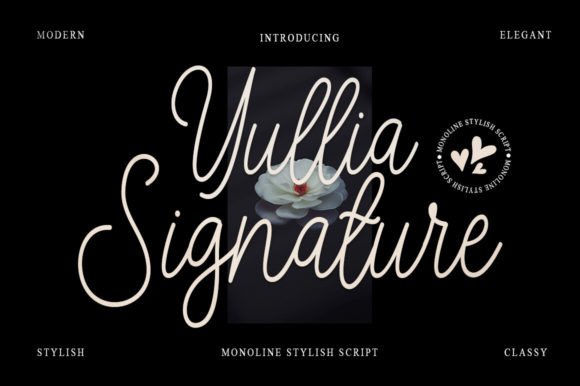
Yullia Signature: The Handwritten Elegance That Feels Like Yours
If you’ve ever stared at a clean logo mockup and thought, “It’s polished—but where’s the soul?”, or spent 20 minutes tweaking a wedding invitation only to realize it still feels too generic—Yullia Signature might be the quiet solution you’ve been overlooking. It’s not just another script font. It’s a carefully crafted digital interpretation of what happens when ink meets paper under a steady, confident hand: subtle entry strokes, graceful exits, delicate thins, and just enough variation to feel human—not algorithmic.
What Exactly Is Yullia Signature?
Yullia Signature is a premium handwritten-style typeface designed with authenticity in mind. Unlike many script fonts that rely on heavy swashes or exaggerated flourishes, Yullia Signature balances refinement with restraint. Its letters flow naturally, with soft curves, gentle tapering, and organic spacing—no awkward collisions, no forced ligatures. It includes standard Latin characters, numerals, punctuation, and multilingual support for Western European languages, making it practical for real-world use—not just mood boards.
Where It Fits Best (and Where It Doesn’t)
Yullia Signature shines where personality matters more than uniformity. But it’s not a one-size-fits-all tool—and that’s intentional. Here’s how different people actually use it, day to day:
- Small business owners use it for boutique branding—think handmade soap labels, local café menus, or artisanal packaging. One candle maker replaced her generic sans-serif logo with Yullia Signature paired with a minimalist serif for body text, and saw a 30% uptick in Instagram saves on product photos. Why? Because customers subconsciously associate that handwriting-like quality with care, craft, and intention.
- Freelance designers and marketers reach for it when clients ask for “something warm but professional”—like a therapist’s website header, a life coach’s email signature, or a nonprofit’s donor thank-you card. It adds humanity without sacrificing credibility. One copywriter told us she uses Yullia Signature exclusively for client-facing PDFs (media kits, proposals, pitch decks) because “it makes me feel like I’m handing over something personal—not a template.”
- Educators and course creators apply it sparingly but effectively: on certificate headers, workshop handouts, or welcome slides in online courses. A Montessori teacher uses it for student award ribbons (“Best Listener,” “Most Thoughtful Question”)—not as body text, but as a meaningful visual anchor that signals celebration, not bureaucracy.
- Bridal designers and stationers rely on it for envelope addressing, monogrammed napkins, or vow books. It works especially well when printed on textured cotton paper—the slight imperfections in the substrate echo the font’s organic rhythm, reinforcing the tactile, made-with-love feeling.
- Bloggers and content creators embed it in featured quote graphics or newsletter banners. Not for long paragraphs—never for body copy—but as a focal point that invites pause. One food blogger uses it only for recipe titles (“Grandma’s Cardamom Rolls”) while keeping ingredients and instructions in a clean, readable sans-serif. The contrast creates hierarchy *and* warmth.
When to Pause Before You Type
Yullia Signature isn’t meant for everything—and knowing its limits helps you use it better. Avoid it for:
- Small-screen UI elements (like mobile app buttons or form labels), where legibility trumps elegance;
- Long-form print materials (e.g., a 40-page program guide), unless used strictly for headings or decorative accents;
- Situations requiring strict brand consistency across multiple languages with complex scripts (e.g., Arabic, Devanagari)—it supports Latin-based languages well, but isn’t built for global multilingual systems;
- Brands aiming for bold, tech-forward, or ultra-modern identities—its strength lies in intimacy, not innovation.
How to Use It Well (Without Overthinking It)
You don’t need design training to get good results. Start simple:
- Pair it intentionally. Try Yullia Signature with a neutral, highly legible sans-serif (like Inter, Lato, or even system fonts like Segoe UI) for contrast. Avoid pairing it with other decorative scripts—that creates visual noise, not harmony.
- Size matters—especially digitally. On websites, use it at 36px or larger for headlines. For print, 24pt+ gives it room to breathe. At smaller sizes, the delicate strokes start to blur or disappear on lower-res screens.
- Use OpenType features if available. Some versions include alternate characters and contextual ligatures. Turn those on in design apps (Illustrator, Affinity, Figma) to let letters connect more naturally—especially in words like “love,” “forever,” or “signature.”
- Test before you commit. Print a sample on your intended paper stock, or view it on an actual phone screen—not just your high-end monitor. What looks stunning in a mockup can feel fragile in practice.
Real Impact, Not Just Aesthetics
People don’t remember fonts—they remember how something made them feel. A wedding guest doesn’t analyze kerning on an invitation; they notice whether it made them smile before opening it. A potential client doesn’t study your logo’s x-height—they sense whether your brand feels approachable or distant. Yullia Signature works because it taps into that unspoken layer: the impression of time taken, attention paid, and intention behind every curve.
That’s why a freelance photographer uses it only on her “About Me” page headline—not her portfolio grid. Why a ceramicist applies it to the backstamp on each mug, not the shop banner. Why a homeschool parent chose it for her child’s weekly learning tracker—it turns routine into ritual.
It won’t fix weak messaging or poor strategy. But when your words are thoughtful, your service is genuine, and your offering has heart, Yullia Signature becomes the quiet, elegant handshake that says, “This was made for you—not for everyone.”
Getting Started Is Simple
Yullia Signature is available as a desktop font (OTF/TTF) and web font (WOFF2), with licensing options for personal use, small teams, or commercial distribution. Always check the license before using it in client work or products you sell—some versions allow unlimited projects, others require per-use clearance. And if you’re evaluating alternatives, compare how the lowercase “g,” “y,” and “a” behave in context—not just in specimen sheets. Those letters often reveal whether a script font feels alive or automated.
At its core, Yullia Signature isn’t about trendiness. It’s about resonance. It’s the difference between signing your name on a contract and signing it on a love letter—same hand, different weight, same intention, deeper meaning.