Filmgoer: The Handwritten Font That Feels Like a Love Note
Ever seen a font that makes you pause mid-scroll—not because it’s flashy, but because it feels human? That’s Filmgoer. It’s not polished to perfection. It doesn’t try to impress with sharp edges or rigid symmetry. Instead, Filmgoer leans in—slightly uneven, warmly imperfect, and quietly confident in its casual handwritten charm.
What Exactly Is Filmgoer?
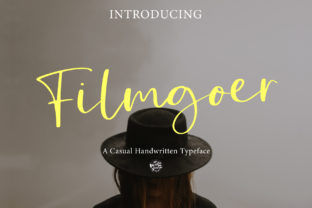
Filmgoer is a casual script typeface designed with soft curves, gentle slants, and subtle variations in stroke weight—just like real pen-on-paper writing. It wasn’t built for headlines screaming for attention. It was made for moments that breathe: a whispered “yes” on a wedding invitation, a heartfelt quote tucked into a blog sidebar, or the quiet elegance of a small-batch skincare brand’s label.
Unlike many script fonts that rely on dramatic flourishes or formal calligraphy rules, Filmgoer keeps things grounded. Its lowercase ‘a’ has a friendly loop. Its ‘g’ curls just enough—not too much, not too little. Even the spacing between letters feels intentional, like someone took time to write it slowly, thoughtfully.
Who Finds Magic in Filmgoer?
You don’t need to be a designer—or even own design software—to get why Filmgoer resonates. Here’s who reaches for it again and again:
- Wedding planners and couples choosing invitations, signage, or vow books—because love stories deserve warmth, not rigidity.
- Small business owners launching handmade goods, boutique studios, or wellness brands where authenticity matters more than corporate polish.
- Bloggers and content creators adding personality to quotes, email headers, or social graphics without shouting.
- Print designers working on greeting cards, packaging, or stationery that’s meant to be held, not just scrolled past.
- Teachers and educators crafting classroom posters or student handouts that feel inviting—not intimidating.
Where Does Filmgoer Shine (and Where Might It Step Back)?
Filmgoer thrives in contexts where tone and feeling carry as much weight as the words themselves. Think:
- A lavender-scented candle label with “slow down” in soft, looping Filmgoer lettering.
- A minimalist wedding suite where the couple’s names sit gently at the top—no borders, no embellishments, just Filmgoer doing the emotional heavy lifting.
- A personal blog post about grief or joy, where a short quote in Filmgoer acts like a quiet nod between writer and reader.
But let’s be real: Filmgoer isn’t your go-to for dense paragraphs, legal disclaimers, or mobile app buttons. Its charm lies in restraint—and that means it works best when used sparingly and intentionally. If you’re building a tech startup’s main website or designing a subway map, this isn’t the font to lead with. It’s not built for speed or scanning. It’s built for savoring.
Why “Casual Handwritten” Isn’t Just a Trend—it’s a Tool
In a world saturated with sleek sans-serifs and algorithmically perfect UI fonts, Filmgoer offers something rare: visual empathy. When people see handwriting—even digital handwriting—they subconsciously register care, effort, and individuality. That’s why Filmgoer often lands so well in feminine-leaning branding: it echoes qualities like intuition, gentleness, and connection—but without stereotyping. It’s equally at home on a gender-neutral apothecary label or a non-binary artist’s portfolio site.
And yes—it’s optimized for real-world use. It includes standard OpenType features (ligatures, alternate characters), supports multilingual Latin-based languages, and renders cleanly across platforms—from print to web (via @font-face or variable font options). You won’t hit a wall trying to use it in Canva, Adobe Creative Cloud, or even Google Docs (with proper upload).
A Few Practical Notes Before You Type
If you’re considering Filmgoer for a project, keep these in mind:
- Pair it wisely. It loves clean, airy companions—think Lora, Playfair Display, or even a light-weight Inter for body text. Avoid pairing it with other scripts or overly decorative fonts; it’ll compete instead of complement.
- Size matters. At small sizes (<14px), details soften. For web use, stick to 18px+ for headings and 24px+ for featured quotes. In print? 12pt is usually safe for elegant captions—but test first.
- Color choice changes the mood. Black gives it classic sincerity. Soft charcoal adds quiet sophistication. Dusty rose or sage green? Instant warmth. Avoid neon or high-contrast combos unless irony is part of your brand voice.
- It’s not free—but it’s fairly priced. Most reputable sellers offer single-user licenses starting under $30, with extended options for teams or commercial use. Always check the license before using it in client work or products for resale.
Real Projects, Real Impact
Take Maya, a ceramicist in Portland. She switched from a generic script to Filmgoer for her online shop’s “About” page—and saw a 22% increase in time-on-page over three months. Customers told her the story felt “more like a conversation.” Or consider Ben, a freelance writer who added Filmgoer to his newsletter’s sign-off line (“With curiosity, —Ben”). His open rate ticked up—not dramatically, but steadily. Readers said it felt “like getting a note from a friend.”
Even in unexpected places, Filmgoer finds footing. A therapist uses it for her session reminder emails (“You’ve got this.”). A nonprofit focused on teen mental health uses it in Instagram carousel quotes—softening heavy topics without diluting their importance.
Is Filmgoer Right for *Your* Project?
Ask yourself:
- Does this project benefit from warmth, intimacy, or approachability?
- Will the font appear in moments meant to linger—not skim?
- Is legibility at smaller sizes secondary to emotional resonance?
- Do you have control over typography (e.g., not locked into a template with fixed fonts)?
If you answered “yes” to most of those, Filmgoer is likely a strong fit. If your priority is ultra-fast readability, strict accessibility compliance (like WCAG AA at tiny sizes), or bold visual dominance, you might explore alternatives first.
The Quiet Power of Choosing Well
Typography is never neutral. Every font carries quiet assumptions—about who’s speaking, who’s listening, and what kind of space we’re sharing. Filmgoer doesn’t demand attention. It invites it. It doesn’t shout values—it embodies them: care, presence, humanity.
That’s why it sticks around. Not because it’s trendy, but because it meets real needs—ones that don’t always show up in analytics dashboards, but live in the way someone pauses to re-read a sentence, smiles at a greeting card, or saves a quote because it felt like it was written just for them.
So whether you're sketching a logo on napkin paper or fine-tuning a Shopify theme, remember: the right font isn’t just about looking good. It’s about feeling true. And for thousands of creators, Filmgoer keeps delivering that truth—one gentle curve at a time.