Serfine: Handwritten Elegance, Engineered for Real-World Use
What Is Serfine — And Why It Feels Different
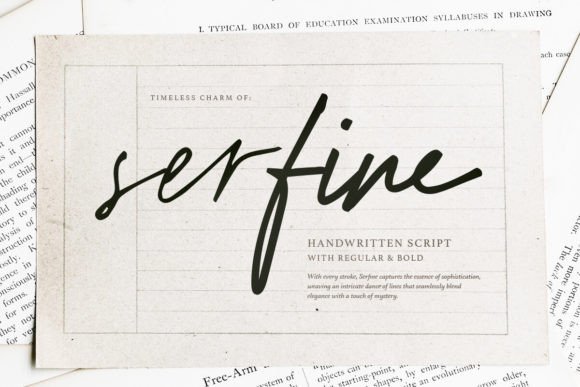
Serfine isn’t just another script font. It’s a signature script—designed from the ground up to mirror the warmth, rhythm, and intentionality of authentic handwriting. Every curve, every connection, every subtle lift and flow was crafted with purpose—not algorithmically generated, but thoughtfully drawn. That’s what gives Serfine its distinctive charm: it breathes like human writing does, without sacrificing clarity or versatility.
At its core, Serfine features rich ligatures: natural letter combinations that flow seamlessly—like “fi”, “fl”, “th”, or even longer joins such as “script” or “beautiful”. These aren’t decorative extras; they’re functional tools that help maintain visual continuity and readability, especially at larger sizes or in tight compositions.
Two Styles, One Consistent Voice
Serfine comes in two carefully balanced weights: Regular and Bold. Neither overwhelms nor fades into the background. The Regular style offers graceful subtlety—ideal for invitations, personal branding, or delicate web overlays. The Bold variant adds presence without stiffness—perfect for logos, hero text, or any context where you need impact grounded in authenticity.
Crucially, both styles share identical proportions, spacing, and ligature logic. That means switching between them mid-design won’t break your layout or disrupt your message’s tone. You’re not choosing between two fonts—you’re selecting the right emphasis within one cohesive voice.
Where Serfine Fits Naturally (and Where It Doesn’t)
Serfine shines brightest when used intentionally—not as body text, but as a strategic accent. Think of it like a well-placed signature on a hand-signed letter: meaningful because it’s selective.
- Digital signatures: Add warmth to e-signature fields, email footers, or PDF certificates—without looking generic or auto-generated.
- Logos & branding: Small businesses, creatives, and service-based professionals use Serfine to convey approachability and craftsmanship—especially when paired with clean sans-serifs (like Inter or Montserrat) or classic serifs (like Merriweather or Lora).
- Quotes & social graphics: A single line of inspiration, pulled from a blog post or podcast episode, becomes more memorable—and shareable—when set in Serfine.
- Print collateral: Wedding stationery, boutique packaging, or artisan product labels gain tactile resonance, even on screen.
It’s less suited for long paragraphs, data tables, or interfaces requiring rapid scanning—just as you wouldn’t write a legal contract in cursive. That’s not a limitation; it’s clarity of intent. Serfine knows its role—and excels within it.
Languages Supported: Designed for Reach, Not Just Aesthetics
Serfine supports multiple languages, including English, Spanish, French, German, Italian, Portuguese, Dutch, Swedish, Norwegian, Danish, Finnish, Polish, Czech, Slovak, Slovenian, Croatian, Romanian, Turkish, Greek, and Vietnamese—with full diacritic coverage (á, ñ, ü, ø, ł, č, š, etc.). This isn’t token support. Accents are redrawn to match the script’s natural slant and weight, preserving harmony across languages.
That makes Serfine practical for global creators—freelancers designing for international clients, educators building multilingual course materials, or small brands expanding beyond local markets. You won’t need to swap fonts mid-project just to accommodate language variation.
How It Works With Other Fonts (Spoiler: Very Well)
One common hesitation around script fonts is pairing anxiety—“Will it clash? Will it look forced?” Serfine was built to coexist. Its x-height aligns thoughtfully with popular sans-serifs and serifs, and its baseline consistency prevents awkward vertical misalignment.
Try these pairings:
- Serfine Bold + Inter Medium: Modern, confident, and accessible—great for startup landing pages.
- Serfine Regular + Lora Italic: Literary, refined, and quietly authoritative—ideal for author websites or editorial features.
- Serfine Regular + Roboto Condensed: Clean contrast for event posters or workshop announcements.
The key isn’t matching styles—it’s balancing energy. Serfine brings movement; your companion font provides structure. Together, they create visual hierarchy that guides the eye, not confuses it.
Real People, Real Projects: How Serfine Is Being Used Today
A freelance graphic designer uses Serfine Regular to sign off client deliverables—not as a watermark, but as a quiet mark of care. Recipients notice it. They screenshot it. It becomes part of the brand experience.
A yoga studio owner pairs Serfine Bold with Open Sans to design class schedule cards. The script conveys calm intention; the sans-serif delivers clarity. Parents glance at the card once—and remember both the name and the feeling.
An indie publisher sets book chapter titles in Serfine Regular, while body text stays in a highly readable serif. Readers subconsciously associate the script with transition, reflection, and narrative pause—enhancing emotional pacing without a single word changed.
None of these uses require advanced typography knowledge. They rely instead on intuitive fit—something Serfine delivers by design.
Things to Keep in Mind Before You Choose
Serfine is optimized for display use—not micro-text. At sizes below 16px, some ligatures may lose definition, and fine strokes can render inconsistently across devices. For best results, use it at 20px and up on screens, and 14pt+ in print.
While it supports many languages, it doesn’t include extended Cyrillic, Arabic, Hebrew, or East Asian character sets. If your project requires those, plan for fallback solutions—or consider Serfine as a complementary element rather than a primary text face.
And though it’s versatile, Serfine rewards thoughtful application. Dropping it into every heading on a website dilutes its impact. Like good lighting or intentional whitespace, its power lies in restraint.
Is Serfine Right for Your Next Project?
Ask yourself:
- Do you want text that feels personal—not programmed?
- Are you aiming to reinforce trust, creativity, or craftsmanship—not speed or utility?
- Will this appear in contexts where tone matters as much as information?
- Do you need flexibility across languages—but not full global script coverage?
If three or more answers are “yes,” Serfine is likely a strong fit. It’s not about trendiness. It’s about resonance—how your words land, not just how they read.
You don’t need to overhaul your entire design system to start with Serfine. Try it on one thing first: your email signature, your portfolio headline, the tagline on your Instagram highlight cover. See how it changes the temperature of your communication—even slightly. That’s often where the most meaningful design decisions begin.
Serfine invites intention. It doesn’t shout. It leans in. And in a world saturated with uniformity, that quiet distinction is anything but small.