Baking: Elegant Handwritten Typography, Refined
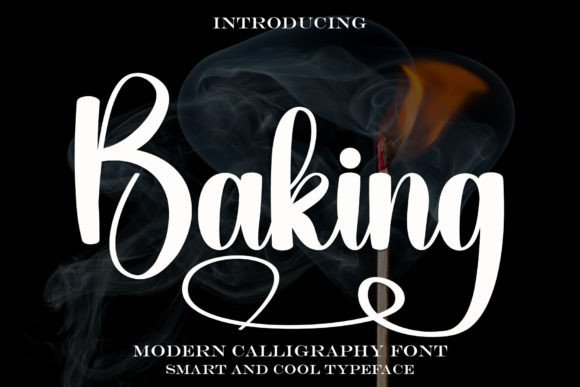
If you’ve ever paused mid-scroll on a beautifully crafted wedding invite, a boutique coffee bag, or a minimalist Instagram story—just to admire the lettering—you’ve felt the quiet power of a thoughtful script font. Baking isn’t just another handwritten typeface. It’s a deliberate fusion of classic calligraphic discipline and contemporary restraint: fluid yet controlled, expressive yet legible, warm yet polished. Its lowercase “a” and “g” carry subtle ball terminals; its ascenders rise with gentle confidence; its spacing breathes without looseness. This isn’t messy chalkboard scrawl or over-embellished flourishes—it’s handwriting refined through intention.
Where Baking Earns Its Place—Not Just Its Looks
Baking thrives where authenticity meets polish. Think: a small-batch candle brand launching its first line of soy wax vessels—their product photography soft-lit, their voice calm and intentional. A serif body font like Merriweather or Lora pairs naturally with Baking for headlines, giving hierarchy without contrast fatigue. In editorial design, it works exceptionally well for pull quotes in lifestyle magazines or seasonal newsletters—adding human texture without sacrificing clarity at 24–36pt sizes.
It’s also quietly effective in digital spaces that value craft: social media graphics for independent bookshops, email headers for artisanal baking classes, or even subtle watermark text on portfolio thumbnails. Because Baking avoids exaggerated swashes or unpredictable joins, it scales reliably across devices—unlike many script fonts that collapse into illegibility below 28px on mobile.
What doesn’t suit it? Long-form body copy (it’s a display font, not a workhorse), ultra-minimalist tech branding (where geometric sans serifs like Inter or Neue Haas Grotesk anchor credibility), or high-contrast luxury sectors like fine jewelry—where Didot or Bodoni carry more traditional weight. Baking leans into warmth, not austerity.
How It Shapes Perception—Without Saying a Word
Typefaces don’t communicate in sentences—but they do set tonal expectations before your audience reads a single word. Baking signals care, attention to detail, and quiet confidence. That’s why designers working with wellness coaches, ceramic studios, or sustainable textile labels consistently reach for it: it aligns with values like intentionality and craftsmanship without shouting.
Readability here is selective—and that’s by design. At headline size (32–60pt), its open counters and balanced x-height ensure quick recognition. At smaller sizes—say, 14pt for a tagline beneath a logo—it remains decipherable but begins to soften, inviting slower reading. That slight deceleration is useful: it encourages pause, reflection, connection. In packaging design, that pause can tip the balance between scanning and choosing.
Consistency matters too. Because Baking includes only carefully curated weights—not a sprawling family of 12 variants—it nudges you toward disciplined usage. You’re less likely to over-style and more likely to build recognizable rhythm across touchpoints: same weight for all logos, same size range for all social banners, same pairing logic across print and web. That repetition builds brand recognition faster than inconsistency ever could.
Practical Fit: Testing, Pairing, and Licensing
Before committing, ask two questions: Is this voice mine—or does it serve my audience? And Does it hold up where I need it most? Test Baking in context—not just as a standalone sample, but overlaid on real imagery, beside actual body text, and at the exact sizes you’ll use. Try it in Figma or Adobe XD with your brand’s primary color palette. Does it retain contrast against soft beige backgrounds? Does it feel equally at home on matte paper and glossy screen?
For pairings, start simple. A neutral sans serif like Poppins (Light or Regular) offers clean contrast without competing. For print-heavy projects, try it with a low-contrast serif like Adobe Garamond—it echoes Baking’s classical roots while grounding its energy. Avoid pairing it with other scripts or overly decorative fonts; Baking carries enough personality on its own.
Licensing is straightforward but essential to verify. Baking is a commercial font, meaning personal use (like a hobby blog header) may be covered under standard licenses—but if you’re embedding it in client websites, selling templates, or using it in app interfaces, confirm the license tier explicitly. Most reputable foundries offer clear documentation; look for terms like “web font hosting,” “desktop + web bundle,” or “extended license for SaaS.” Don’t assume “personal use” covers freelance deliverables.
A Few Real-World Observations
A local florist used Baking for her holiday gift tags—printed on recycled kraft stock. The contrast between the tactile paper and the precise, slightly rounded strokes made each tag feel handmade, even though it was digitally printed. Customers photographed them. That’s engagement rooted in typographic empathy.
Another example: a food blogger redesigned her recipe cards using Baking for titles and a tight, highly legible sans serif (like IBM Plex Sans) for ingredients. Bounce rate on recipe pages dropped 12% over three months—readers reported the layout “felt easier to follow,” even though only the headline font changed.
These aren’t magic fixes. They’re evidence that when a script font like Baking aligns with content tone, audience expectation, and functional constraints, it stops being decoration—and becomes part of the message itself.
Final Thought: Choose With Purpose, Not Just Preference
There are dozens of elegant handwritten fonts out there. What makes Baking stand apart is how little it asks you to compromise: elegance without fragility, personality without chaos, tradition without stiffness. It doesn’t beg for attention—it earns it through consistency, clarity, and quiet confidence.
If your project values warmth, craftsmanship, and understated distinction—if your audience responds to sincerity over flash—Baking is worth your time. Not as a trend to chase, but as a considered tool: one that supports your voice instead of overshadowing it.