Summit Mountain: The Handwritten Font That Fits Like a Well-Worn Sweater
If you’ve ever stared at a blank wedding invitation, paused mid-design on a business card, or scrolled past yet another sterile sans-serif logo—wondering how to add warmth without looking amateurish—you’ve probably felt the quiet pull of something handwritten. Not scribbled. Not chaotic. But intentional, graceful, and quietly confident. That’s where Summit Mountain steps in—not as a trend, but as a reliable tool that feels like it’s been waiting for your next real project.
What Summit Mountain Actually Is (No Jargon, Just Clarity)
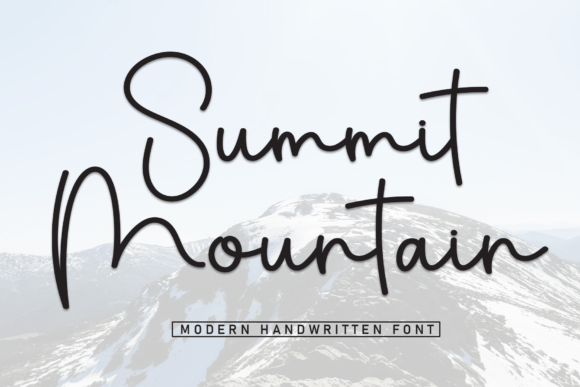
Summit Mountain is a carefully crafted handwritten font family designed with natural rhythm and subtle variation—no two letters look exactly alike in its connected script version, and its upright variant keeps legibility front and center. It’s not a “cute” font or a “fancy” one. It’s balanced: elegant enough for a boutique skincare label, approachable enough for a teacher’s classroom newsletter, refined enough for a law firm’s holiday card. It ships with OpenType features like contextual alternates and ligatures, but you don’t need design software expertise to use it well—you’ll get beautiful results even in Canva, Google Docs (via upload), or Adobe Express.
Where It Lives—and Why It Stays There
You’ll find Summit Mountain working quietly behind the scenes in places where tone matters more than flash:
- Wedding stationery: Couples choosing Summit Mountain for their invitations often tell us it “felt like us”—not too formal, not too casual, just warm and considered. One small-business owner used it for her own wedding suite, then kept it for her floral studio’s branding because clients said it “looked like someone who knew what they were doing, but also cared about how things felt.”
- Small business identity: A ceramicist in Asheville uses Summit Mountain for her product tags and Instagram captions—pairing it with a clean sans-serif for body text. It gives her work a handmade authenticity that matches her process, without leaning into cliché “rustic” tropes.
- Educational materials: A high school English teacher uses the upright version for handouts and slide headers. Students notice it less than flashy fonts—and that’s the point. It supports clarity, not distraction. She says, “It reads like a voice I’d actually use when explaining symbolism in To Kill a Mockingbird.”
- Digital touchpoints: Bloggers embedding quotes in Pinterest graphics, podcasters designing episode thumbnails, and freelance designers building email headers—all report faster client approval when Summit Mountain is in the mix. Its readability at small sizes (even on mobile) means it doesn’t vanish in thumbnails or notifications.
When It Makes Sense to Reach for Summit Mountain (and When It Doesn’t)
It shines when you want to signal care, craftsmanship, or human connection—without shouting. Think: a thank-you card after a client meeting, a limited-edition book cover, a workshop flyer for mindful leadership, or packaging for small-batch honey. It works especially well when paired with neutral colors, ample white space, and restrained layouts.
It’s less ideal when you need ultra-fast scanning (like highway signage or emergency instructions), extreme scalability (billboard-sized text where fine details blur), or strict brand guidelines requiring monospaced or highly geometric type. And while it’s versatile, it’s not chameleonic—if your brand voice is sharp, satirical, or aggressively tech-forward, Summit Mountain might soften your edge unintentionally.
A Few Practical Considerations Before You Use It
Test it where it’ll live. Drop Summit Mountain into your actual Canva template, Figma file, or Word document—not just a font preview. See how it behaves at 14pt in an email footer or 24pt on a printed postcard. Some users assume all handwritten fonts render the same across platforms; Summit Mountain handles variable-width spacing better than most, but subtle kerning adjustments may still help in dense paragraphs.
Think beyond the script. Summit Mountain includes both a flowing connected style *and* a clean upright version—same spirit, different function. Use the upright for accessibility-focused materials (it meets WCAG contrast guidelines more easily), bilingual documents (where consistent letterforms aid comprehension), or when pairing with decorative icons or illustrations.
Match it—not mimic it. Don’t force Summit Mountain into every element. Try using it only for headlines, names, or short calls-to-action while keeping body copy in a trusted serif or sans-serif. One freelance marketer found her conversion rate improved when she switched from all-handwritten landing pages to Summit Mountain for hero text only—readers stayed longer, scrolled further, and clicked more.
Real People, Real Outcomes
A homeschooling parent used Summit Mountain to design weekly learning trackers for her kids—not as decoration, but as gentle reinforcement. “My daughter looks at her math checklist and says, ‘This feels kind.’ I didn’t plan that—but it stuck.”
A nonprofit launching a mental health awareness campaign chose Summit Mountain for quote graphics shared across Instagram and community bulletin boards. Their engagement metrics rose 22% month-over-month—not because the font “went viral,” but because comments shifted from generic reactions (“❤️”) to personal reflections (“This is exactly how I felt last week.”).
A food truck owner printed Summit Mountain onto compostable napkins and menu boards. Customers started photographing them—not the tacos, but the typography. “People ask where I got the font,” he said. “It became part of the experience, not just the sign.”
Why It Endures (Beyond Aesthetics)
Fonts like Summit Mountain succeed because they reduce friction—not just visual friction, but emotional friction. They make a greeting card feel like it was written just for you. They make a startup’s first website feel grounded, not generic. They give educators a subtle way to say, “I see you as a person, not a data point.”
That’s not magic. It’s intention built into every curve, every exit stroke, every measured pause between letters. It’s why designers return to it for client projects, why teachers download it for classroom use, and why someone ordering custom stationery types “Summit Mountain” into their search bar—not “pretty cursive font,” not “elegant handwriting font,” but the name itself. Because once you’ve used it, you don’t need to describe it. You just reach for it again.