Sexy Girl: Where Timeless Calligraphy Meets Modern Design Sensibility
Typography is rarely neutral. Every font carries tone, history, and intention—sometimes whispering elegance, sometimes shouting urgency. Among the thousands of typefaces released each year, only a handful achieve that rare balance: deeply rooted in tradition yet unmistakably at home in today’s digital landscape. Sexy Girl is one such font—a meticulously crafted handwritten typeface that doesn’t merely imitate script; it reinterprets it with intelligence, warmth, and quiet confidence.
The Craft Behind the Curve
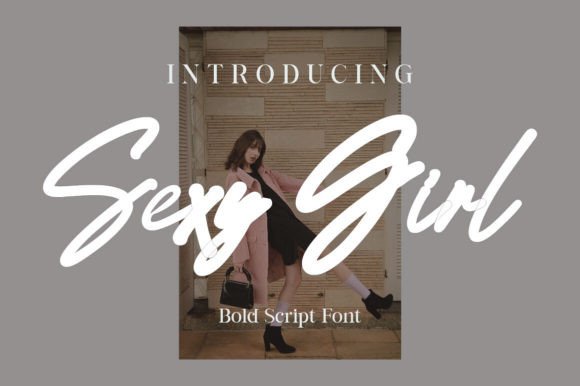
At first glance, Sexy Girl evokes the fluid grace of vintage penmanship—think ink-dipped nibs, subtle pressure variation, and organic rhythm. But look closer: its letterforms are not scanned relics or traced calligraphy. They’re original drawings—each glyph shaped by deliberate design decisions. The lowercase “a” features a soft, open bowl with a gently tapered tail; the uppercase “S” flows with a confident, asymmetrical swell that avoids mechanical symmetry without sacrificing legibility. These aren’t accidents. They’re evidence of deep typographic literacy.
What distinguishes Sexy Girl from generic “handwritten” fonts is its intentional restraint. It avoids excessive flourishes, overdone swashes, or exaggerated bounce—choices that often undermine readability at scale or in interface contexts. Instead, it leans into subtlety: slight contrast between thick and thin strokes, consistent x-height, and generous spacing baked into the metrics. That means it performs well not just on a wedding invitation, but also in a boutique brand’s mobile app UI, an educator’s printable worksheet, or a researcher’s presentation slide where personality matters—but clarity is non-negotiable.
Who Finds Value in This Kind of Type?
Sexy Girl resonates across disciplines—not because it’s universally “safe,” but because it serves specific expressive needs with precision. Its appeal isn’t demographic; it’s functional and emotional.
- Creative professionals—graphic designers, branding consultants, and art directors—reach for Sexy Girl when they need to signal authenticity without cliché. A skincare startup might use it for product names (“Lumière Serum,” “Velvet Bloom”) to suggest artisanal care and tactile luxury. Unlike overly ornate scripts, Sexy Girl scales gracefully from favicon-sized logos to billboard headlines.
- Educators and curriculum designers appreciate how its natural stroke direction and open counters support early reading development. In phonics worksheets or bilingual flashcards, it offers visual familiarity—mirroring how children learn to form letters by hand—without sacrificing typographic rigor. One Montessori-aligned resource creator noted that students consistently identified words faster in Sexy Girl than in more rigid sans-serif alternatives during timed recognition exercises.
- Small business owners, especially in lifestyle, wellness, and creative services, find Sexy Girl bridges professionalism and approachability. A freelance photographer uses it for client email signatures and print portfolios—not as decoration, but as tonal continuity. It says, “I take my craft seriously, and I value your attention.”
- Hobbyists and DIY creators integrate it into Canva templates, Cricut projects, and printable planners. Its OpenType features—including contextual alternates and ligatures—allow automatic variation (e.g., the “f” + “i” combination subtly reshapes for smoother connection), giving handmade-feeling results without manual tweaking.
Real-World Applications: Beyond Aesthetics
Fonts don’t exist in isolation—they operate within systems. Sexy Girl was designed with ecosystem compatibility in mind. It includes full Latin character sets (supporting Western, Central, and Eastern European languages), numerals with old-style figures, punctuation optimized for screen legibility, and multilingual diacritics tested across Spanish, French, German, Polish, and Turkish contexts.
Consider these practical implementations:
- Digital publishing: An independent newsletter about slow living uses Sexy Girl for article titles and pull quotes. Its moderate contrast ensures readability on OLED screens, while its rhythm creates breathing room between dense paragraphs—reducing cognitive load without sacrificing voice.
- Print collateral: A university’s continuing education division adopted Sexy Girl for course brochures targeting adult learners. Testing revealed higher engagement with program descriptions set in this font versus their previous serif—respondents described the typography as “inviting but credible,” a critical nuance when conveying academic rigor alongside accessibility.
- Product packaging: A small-batch chocolate maker applies Sexy Girl to ingredient lists and origin stories printed directly on matte-finish wrappers. The font’s slightly irregular baseline mimics hand-lettered labels, reinforcing craftsmanship—yet remains scannable under retail lighting and at arm’s length.
Why “Handwritten” Doesn’t Mean “Unstructured”
A common misconception is that handwritten fonts sacrifice structure for charm. Sexy Girl proves otherwise. Its underlying skeleton follows rigorous typographic principles: consistent vertical stress, harmonized ascender/descender ratios, and optical alignment that accounts for perceived weight—not just geometric placement. For example, the dot above the lowercase “i” sits fractionally higher than centerline to counteract visual sinking—a detail invisible to most viewers but essential to professional rendering.
This structural integrity makes Sexy Girl unusually versatile in mixed-typography layouts. Pair it with a neutral sans-serif like Inter or Lato for body text, and the contrast feels intentional, not jarring. The script provides voice; the sans-serif delivers information. No competing personalities. No tonal whiplash.
Technical Considerations for Implementation
Adopting any font requires awareness of technical boundaries—and Sexy Girl is no exception. While optimized for modern environments (WOFF2, variable axis support planned for future releases), certain scenarios warrant attention:
- Web performance: When self-hosting, serve only the character subsets needed (e.g., Latin + basic punctuation) rather than full Unicode ranges. Most platforms allow subsetting via CSS
@font-facedeclarations or build tools like Fontsource. - Accessibility: Though highly legible, avoid using Sexy Girl for long-form body copy or critical interface labels (e.g., form field instructions). Its decorative nature, while restrained, still falls outside WCAG AA contrast minimums at small sizes. Reserve it for headings, accents, and short-form emphasis—where its expressive strength shines.
- Licensing clarity: Sexy Girl is available under commercial licenses covering desktop, web, app embedding, and even merchandise resale—unlike many free handwritten fonts with ambiguous or restrictive terms. Always verify license scope before deploying in client work or SaaS products.
Observations From the Field
Designers who’ve used Sexy Girl across multiple projects report recurring patterns—not just in outcomes, but in process shifts. One UX writer observed that teams began writing shorter, more evocative headlines once Sexy Girl entered the design system. The font’s inherent expressiveness reduced reliance on adjectives in copy—“Velvet Evening” carried more weight than “Elegant & Luxurious Evening.”
Another trend: increased consistency in cross-platform branding. Because Sexy Girl renders predictably across iOS, Android, and major browsers—even with dynamic text sizing—the gap between Figma mockups and final implementation narrowed significantly. Less time spent troubleshooting kerning overrides or fallback stacks meant more focus on user flow and content strategy.
Not Just Another Script—A Design Partner
Ultimately, Sexy Girl functions less like a static asset and more like a collaborative tool. It doesn’t shout for attention; it invites participation. Its curves encourage slower reading. Its irregularities humanize interfaces. Its craftsmanship reassures users that thought went into every detail—even the ones they’ll never consciously notice.
That’s the mark of mature typography: not novelty for its own sake, but resonance through intention. Whether you’re launching a passion project or refining enterprise communications, Sexy Girl offers something increasingly rare in digital design—warmth without sentimentality, distinction without distraction, and beauty that serves purpose first.
It doesn’t ask to be the loudest voice in the room. It simply makes every word feel worth saying—and worth hearing.