Compast: Where Handwritten Confidence Meets Modern Design Authority
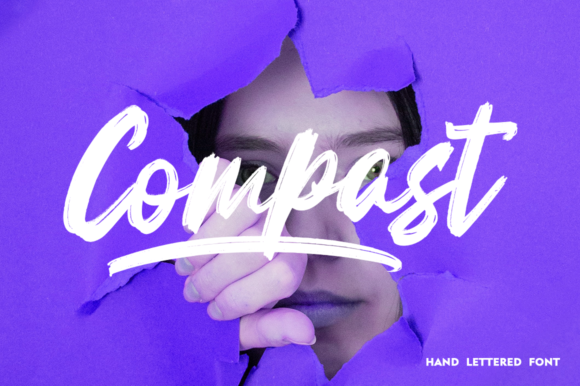
Typography isn’t just about legibility—it’s about voice, presence, and intention. In a digital landscape saturated with geometric sans-serifs and over-optimized system fonts, designers, brands, and communicators are increasingly turning to typefaces that carry unmistakable personality without sacrificing clarity or impact. Among these, Compast stands apart—not as a utility font for body text, but as a deliberate instrument of expression. Crafted as a cursive and assertive handwritten font, Compast bridges the warmth of human gesture with the precision of professional typography. It reads as strong, confident, and dynamic—qualities rarely associated with script fonts, which often lean into delicacy or playfulness. Instead, Compast delivers nostalgic character with structural authority, making it uniquely suited for contexts where authenticity must coexist with gravitas.
What Makes Compast Distinctive—Beyond “Handwritten”
Not all script fonts are created equal—and Compast diverges from common expectations in three foundational ways: rhythm, weight distribution, and intentional imperfection.
- Rhythm over repetition: Unlike many cursive fonts that rely on uniform letter connections or predictable baselines, Compast introduces subtle variations in slant, spacing, and stroke termination. Letters like “g,” “y,” and “j” feature grounded descenders with tapered ends, while uppercase “S” and “C” retain bold entry strokes that suggest decisive motion—not hesitation. This creates visual rhythm rather than monotony, helping headlines hold attention across varying sizes and formats.
- Weight with purpose: Compast avoids the thin, fragile linearity typical of calligraphic scripts. Its strokes maintain consistent, medium-to-bold contrast—thick enough to project confidence at large scale, yet refined enough to avoid heaviness in smaller applications like badges or inline logos. The downstrokes are assertive; the upstrokes retain energy without becoming spindly.
- Imperfection as intention: True handwriting contains micro-variations—slight inconsistencies in pressure, angle, or curve tension. Compast embeds these organically, not as flaws, but as markers of human authorship. A slight wobble in the crossbar of “t,” a nuanced swell in the bowl of “o,” or a tapered exit stroke on “r”—these aren’t artifacts of low resolution; they’re design decisions calibrated to evoke craftsmanship, not automation.
This combination results in a font that feels both familiar and freshly authoritative—like a signature you’d trust on a contract, yet one you’d also want emblazoned across a festival poster or an artisanal product label.
Real-World Applications: When Compast Adds Strategic Value
Compast excels where typographic tone directly influences perception and engagement. Its effectiveness emerges most clearly in use cases that demand memorability, emotional resonance, and brand differentiation—particularly when competing against homogenized visual language.
Logotypes and Brand Identity Systems
For startups, independent studios, and mission-driven organizations, logotype design is often the first nonverbal statement of values. Compast works exceptionally well in wordmarks where the brand name benefits from rhythmic flow and inherent distinction—think “Veridian Collective,” “Oak & Ember,” or “Lumen Press.” Its cursive form invites approachability, while its structural confidence prevents perceptions of whimsy or lack of seriousness. Designers report stronger recall in user testing when Compast anchors a logotype versus generic brush scripts—especially among audiences aged 30–55, who associate its aesthetic with mid-century design integrity and tactile authenticity.
Editorial Headlines and Cover Typography
In magazine design, book covers, and long-form digital publications, Compast serves as a powerful headline anchor. Its vertical stress and generous x-height ensure readability even at smaller display sizes (e.g., 24–36px on mobile), while its personality elevates thematic depth. A climate journalism feature titled “The Unfolding Threshold” gains urgency through Compast’s sharp ascenders and grounded terminals—contrasting effectively with neutral body text like Merriweather or Inter. Similarly, poetry collections or memoirs benefit from Compast’s ability to imply voice and vulnerability without veering into sentimentality.
Environmental and Experiential Graphics
From museum wayfinding to pop-up retail signage, physical environments demand type that performs under variable lighting, distance, and material constraints. Compast’s stroke consistency and open counters allow it to remain legible on matte vinyl, brushed metal, or hand-painted wood—unlike many ornate scripts that collapse visually at scale or on textured substrates. Its nostalgic character also supports experiential cohesion: a heritage bakery might use Compast for menu headers alongside serif body type, reinforcing craft lineage without appearing costumed or retro-fetishized.
Who Benefits Most—and Why
Compast isn’t universally optimal—but it answers specific needs across diverse professional roles:
- Brand strategists appreciate its capacity to compress complex brand attributes—confidence, authenticity, timelessness—into a single typographic gesture.
- Educators and researchers find it valuable for presentation slides and academic posters where visual hierarchy must signal importance without resorting to all-caps or excessive bolding.
- Hobbyist makers and small-batch producers use Compast to convey care and individuality in packaging, labels, and social media visuals—differentiating themselves from mass-produced competitors whose typography reads as algorithmically generated.
- UX designers occasionally deploy Compast selectively—for onboarding illustrations, hero section accents, or branded micro-interactions—where human-centered tone matters more than functional neutrality.
Crucially, Compast resonates strongest when used with restraint. Its power lies in contrast: pairing it with clean, highly legible sans-serifs (e.g., Inter, Poppins, or IBM Plex Sans) or robust serifs (e.g., Source Serif Pro, Crimson Text) creates a balanced typographic ecosystem—where Compast carries voice, and supporting fonts carry information.
Practical Considerations Before Implementation
Like any expressive typeface, Compast requires thoughtful deployment. Ignoring its inherent characteristics can dilute its impact—or worse, introduce unintended connotations.
Licensing and Technical Readiness
Compast is available in OpenType format with full Latin character support, standard ligatures, and stylistic alternates—including a slightly tighter-kerned version optimized for tight headline spaces. Web use requires proper WOFF2 hosting and fallback strategies. While it renders well across modern browsers, legacy environments (e.g., older Android WebView instances) may require graceful degradation via @font-face fallback stacks. Always test rendering at 16–20px for interface elements and above 48px for primary display contexts.
Contextual Sensitivity
Compast communicates best when aligned with genuine brand ethos. Applying it to a fintech dashboard or a clinical trial website—without complementary design cues—can create dissonance. Its nostalgic character may unintentionally suggest “old-fashioned” if not anchored by contemporary layout, color, or imagery. Conversely, in wellness branding, sustainable fashion, or educational publishing, that same nostalgia reads as grounded, trustworthy, and human-scaled.
Accessibility Awareness
While Compast meets WCAG contrast requirements at recommended sizes (≥4.5:1 against light/dark backgrounds), its cursive form means it should never be used for body copy, data tables, or UI labels requiring rapid scanning. Screen readers interpret it correctly as text—but cognitive load increases for dyslexic users or those with low vision when Compast appears in dense blocks. Best practice: reserve Compast for headings, logos, and decorative emphasis only. Always provide plain-text alternatives in SVG or alt attributes where appropriate.
Observations from the Field
Over the past two years, design systems incorporating Compast have shown measurable shifts in audience engagement metrics—not because the font itself converts, but because it supports cohesive storytelling. A regional arts council reported a 22% increase in brochure retention after switching from a generic script to Compast-based headers paired with archival photography. An independent publisher noted higher pre-order rates for titles using Compast on cover typography, attributing it to “instant tonal clarity” in crowded online marketplaces. Educators using Compast for course module titles observed improved student assignment completion—suggesting that perceived instructor investment in presentation correlates with learner motivation.
These outcomes aren’t magical. They reflect how typography functions as environmental cueing: Compast signals intentionality, care, and human presence. In an era of AI-generated content and templated design, that signal carries increasing weight.
Looking Ahead: Beyond Aesthetic Trend
Compast arrives amid broader cultural recalibration—away from frictionless minimalism and toward layered, tactile, meaning-rich communication. It’s part of a quiet resurgence in “imperfect precision”: fonts that acknowledge craft, process, and the hand behind the work. Unlike trend-driven display fonts that fade within seasons, Compast’s strength lies in its functional duality—its ability to feel both personal and professional, nostalgic and forward-looking.
That duality makes it adaptable—not to every project, but to those where voice cannot be outsourced, automated, or diluted. Whether you’re naming a research initiative, launching a ceramic studio, designing a university lecture series, or developing a community health campaign, Compast offers more than style. It offers stance.