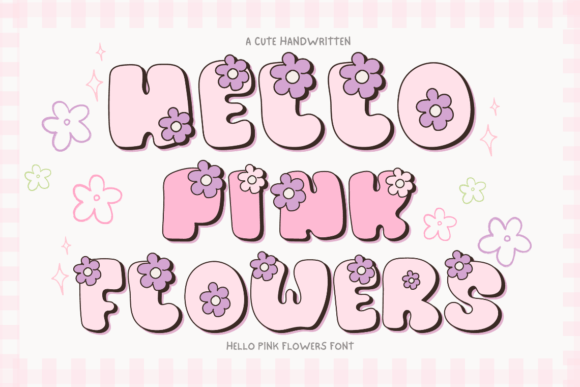
Hello Pink Flowers Font
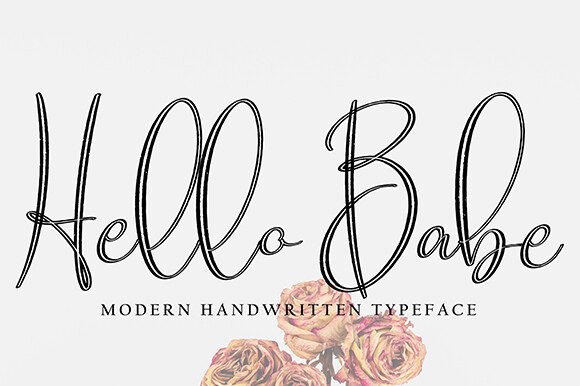
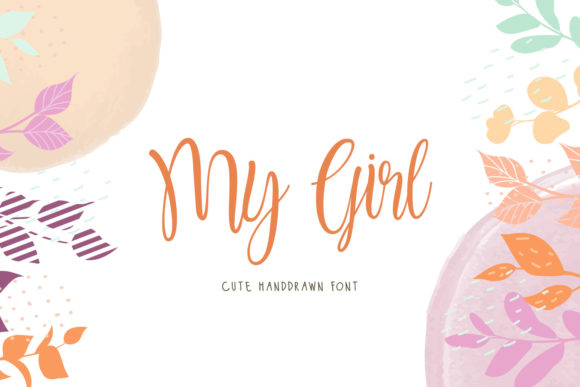
Hello Pink Flowers is a carefully crafted handwritten typeface that evokes the softness and spontaneity of spring blooms—think delicate petals, gentle curves, and organic rhythm. It’s not just another floral font; it’s designed with intention, balancing legibility and charm across real-world applications. Unlike many decorative scripts that sacrifice clarity for ornamentation, Hello Pink Flowers maintains readability at medium sizes while preserving its hand-drawn warmth. The lowercase letters feature subtle flourishes, the capitals carry a light, airy confidence, and the included floral swashes and alternate characters offer flexibility without overwhelming the composition.
What Sets Hello Pink Flowers Apart
Most handwritten fonts fall into one of two categories: highly stylized (often difficult to read in body text or small formats) or overly simplified (lacking personality). Hello Pink Flowers occupies a thoughtful middle ground. Its baseline consistency, moderate x-height, and open counters make it more versatile than many script fonts in its category. The floral motif isn’t applied as clipart—it’s integrated into the letterforms themselves: the tail of the “y” curls like a vine, the dot on the “i” resembles a tiny blossom, and connecting strokes mimic stem-like continuity.
This integration matters when evaluating usability. For example, using Hello Pink Flowers for a wedding invitation header works because it conveys romance without sacrificing formality. In contrast, a font with heavy embellishments might look charming on a large poster but become muddy on a business card or mobile screen. Similarly, its spacing has been fine-tuned for pairing—especially with clean sans-serifs or light serifs—making it practical for layered layouts like social media graphics or magazine spreads.
Where Hello Pink Flowers Fits in Practice
Designers often reach for floral or handwritten fonts in specific contexts: seasonal branding, personal stationery, boutique packaging, or lifestyle content. Hello Pink Flowers excels in scenarios where authenticity and approachability are priorities—but professionalism still matters. Consider these realistic examples:
- A small florist launching a spring collection uses Hello Pink Flowers for product tags and Instagram story headers, then pairs it with a neutral sans-serif for pricing and descriptions—achieving visual warmth without compromising scannability.
- A planner designer incorporates Hello Pink Flowers into printable monthly headers and habit tracker titles. Its natural flow supports daily engagement without feeling childish or overly cutesy.
- An independent wedding stationer selects Hello Pink Flowers for “Mr. & Mrs.” on invitations but avoids using it for full addresses—opting instead for a crisp, high-contrast serif for clarity and postal compliance.
In each case, the decision hinges not on trendiness, but on functional fit: how well the font supports hierarchy, tone, and audience expectations. Hello Pink Flowers doesn’t try to replace system fonts or robust UI typefaces—it complements them.
Comparing Approaches: When Handwritten Fonts Work—and When They Don’t
Handwritten fonts like Hello Pink Flowers serve a distinct purpose: they signal individuality, care, and human touch. That makes them valuable in creative industries, personal projects, and brand identities centered on craft or nature. But their strengths come with built-in constraints.
For instance, long-form reading—such as blog posts, product manuals, or email newsletters—is rarely appropriate for script fonts. Hello Pink Flowers lacks the typographic infrastructure (like extensive language support, optical sizing variants, or OpenType features for automatic ligatures) needed for extended text. It also performs best in color-rich or lightly textured backgrounds; placing it over busy photography or low-contrast gradients can reduce legibility quickly.
Compare this to a variable sans-serif: it scales predictably, adapts to responsive layouts, and handles accessibility requirements (like screen reader compatibility and WCAG contrast ratios) more readily. Hello Pink Flowers isn’t meant to compete with those tools—it fills a different role entirely. Think of it less as a replacement and more as a deliberate accent: the handwritten note on a printed menu, the title treatment on a podcast cover, the tagline in a boutique’s Instagram bio.
Practical Tradeoffs to Keep in Mind
Before incorporating Hello Pink Flowers into a project, consider these realistic tradeoffs:
- Licensing scope: Most versions are licensed for personal and commercial use, but check whether web embedding, app integration, or merchandise resale is covered—some licenses restrict usage in digital products sold to end users.
- Language support: Hello Pink Flowers typically covers basic Latin characters (A–Z, a–z, numerals, common punctuation), but may not include extended diacritics, Cyrillic, or Greek. If your audience includes multilingual speakers or global markets, verify coverage before committing.
- Editing flexibility: As a static font file (not a variable or parametric design), adjustments like weight shifting or width scaling aren’t possible within the font itself. Designers need to rely on layer effects or manual vector edits if variations are required.
- File size and performance: While not unusually large, custom fonts do add to page load time—especially if self-hosted. For websites where speed is critical, Hello Pink Flowers is best reserved for headings or hero sections, not full-page typography.
When Hello Pink Flowers Is Likely the Right Choice
Hello Pink Flowers shines when the goal is to evoke sincerity, seasonality, or artisanal quality—not when neutrality, scalability, or universal legibility are top priorities. It suits projects where the audience values tactile, human-made aesthetics: handmade goods, wellness brands, garden-related services, indie publishing, or celebratory content like baby announcements and birthday invites.
It’s especially effective when used selectively. A website might use Hello Pink Flowers only for the H1 on the homepage and blog post titles, while relying on system fonts elsewhere. A sticker pack could feature Hello Pink Flowers for short phrases (“Bloom Daily”, “Hello Spring”) but avoid it for longer quotes or instructions. This kind of intentional restraint helps preserve its impact and avoids visual fatigue.
When Another Option May Be More Appropriate
If your project demands high readability at small sizes—say, on product packaging labels or mobile app buttons—Hello Pink Flowers won’t be optimal. Similarly, if you’re building a brand identity that must translate seamlessly across voice interfaces, signage, or translated materials, a more neutral, widely supported type family will provide greater consistency and longevity.
There’s also the matter of audience alignment. A tech startup targeting enterprise clients would likely find Hello Pink Flowers incongruent with expectations around reliability and precision—even if executed beautifully. Meanwhile, a local herbal apothecary or botanical illustration course may find it perfectly resonant.
Making an Informed Choice
Choosing a font like Hello Pink Flowers isn’t about finding the “best” option—it’s about matching expressive intent with functional reality. Ask yourself: What emotion or message does this piece need to convey? Who will interact with it, and under what conditions? How much control do I have over surrounding elements (color, spacing, layout)?
Testing matters. Try Hello Pink Flowers alongside your existing palette and layout structure—not just in isolation. Render it at actual sizes: on a printed business card, inside a 300-pixel-wide social ad, as a heading on a dark-mode webpage. See where it holds up and where it falters. Compare it side-by-side with alternatives—not to declare a winner, but to clarify differences in rhythm, contrast, and tone.
Ultimately, Hello Pink Flowers offers something increasingly rare in digital design: a quiet, confident sense of craft. It doesn’t shout. It invites. And when used with awareness—not just aesthetic impulse—it becomes more than decoration. It becomes part of the story.