Close Friends: The Handwritten Font That Turns Everyday Moments Into Meaningful Expressions
Typography is rarely just about letters on a screen or page—it’s about tone, intention, and emotional resonance. In a digital landscape saturated with sleek sans-serifs and minimalist geometrics, Close Friends arrives not as a trend, but as a quiet invitation: to slow down, to personalize, to connect. This isn’t a font designed for corporate dashboards or legal disclaimers. It’s crafted for the margins of life—the grocery list scribbled on a napkin, the affirmation taped to a mirror, the sticker sealing a handmade journal, the quote shared in a Canva story that makes someone pause and smile.
Natural Strokes, Human Rhythm
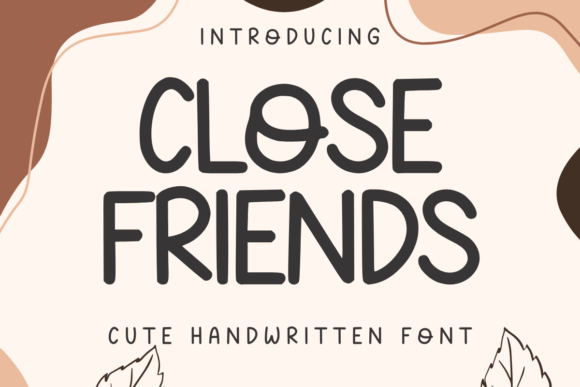
What distinguishes Close Friends from other handwritten fonts isn’t just its aesthetic—it’s its authenticity. Unlike scripts that rely on rigid calligraphic rules or over-smoothed vector paths, Close Friends embraces variation. Its uppercase letters carry gentle asymmetry; lowercase forms breathe with subtle inconsistencies—slight lifts at terminals, soft pressure shifts, and relaxed spacing that mimics real pen-on-paper movement. Punctuation marks—commas, periods, exclamation points—don’t sit stiffly on the baseline. They tilt, rest lightly, or curve inward, reinforcing the impression of a thoughtful hand at work.
This isn’t accidental charm. Each glyph was drawn by hand first, then carefully digitized without over-sanitizing the organic qualities. The result? A typeface that feels familiar—not like something you’ve seen before, but like something you’ve *felt*: the comfort of a friend’s note passed during class, the warmth of a birthday card written in ink, the quiet confidence of handwriting that doesn’t strive for perfection but for presence.
Where Close Friends Fits—and Why It Fits So Well
Practicality matters. A beautiful font loses value if it can’t adapt across tools, sizes, and contexts. Close Friends excels here—not by being technically complex, but by being intentionally versatile.
- Journals and Planners: Its open letterforms and generous x-height ensure legibility even at small sizes (10–12 pt), while its rhythm supports long-form writing without visual fatigue. Users report it encourages consistency in daily journaling—not because it’s “productive,” but because it feels inviting, like returning to a trusted companion.
- Scrapbooking and Sticker Design: Because it includes full punctuation and both uppercase and lowercase sets, designers can build layered, grammatically accurate phrases—not just single-word accents. A sticker reading “breathe. sip. pause.” lands with more nuance than one using only capitals or stylized fragments.
- Educational Materials for Young Learners: Teachers use Close Friends in printable worksheets and classroom posters to model natural handwriting flow—especially helpful for students transitioning from print to cursive. Its clear ascenders and descenders reduce letter confusion (e.g., b/d/p/q), and its friendly proportions support early literacy development without infantilizing content.
- Small-Business Branding (Beyond Logos): While not suited for primary logos requiring scalability and contrast, Close Friends shines in supporting brand voice—on product tags (“hand-poured • small batch • made with care”), packaging inserts, or email newsletter headers. It signals approachability and craftsmanship, particularly in niches like artisanal food, wellness coaching, or handmade goods.
- Digital Creatives Using Canva, Adobe Express, or Cricut Design Space: Its clean OpenType structure ensures reliable rendering across platforms. No missing glyphs, no fallback fonts mid-sentence. Designers consistently note how smoothly it integrates into templates—no manual kerning needed for common word pairs, and automatic ligatures (like “fi” or “fl”) enhance readability without sacrificing character.
Real-World Observations: What Users Notice Over Time
Feedback from diverse users reveals patterns that go beyond initial appeal. Educators observe students more readily engaging with reading passages set in Close Friends versus standard school fonts—particularly those with dyslexic tendencies or attention-related challenges. The slight variation in stroke weight and letter shape appears to aid visual anchoring, reducing letter crowding and improving tracking.
Hobbyists creating bullet journals describe how Close Friends changes their relationship to planning. Rather than treating weekly spreads as tasks to complete, they begin annotating with personal reflections, gratitude notes, or inside jokes—all in the same font. The uniformity becomes a subtle ritual: the same hand, across pages, across weeks, building continuity.
Small apparel businesses report higher perceived value on t-shirts featuring quotes in Close Friends. One customer survey noted that phrases like “soft heart, strong mind” felt “more sincere” and “less generic” when rendered in this font versus popular alternatives. The effect wasn’t about prettiness—it was about perceived intentionality. Buyers associated the font’s naturalism with authenticity in the brand itself.
Thoughtful Implementation: What to Keep in Mind
Like any expressive tool, Close Friends rewards mindful use. Its strengths become limitations when misapplied.
Legibility at distance or small scale remains excellent—but only up to a point. For signage larger than 36 inches or body text smaller than 9 pt in dense layouts, its delicate terminals and thin strokes may blur. Pair it with a sturdy, neutral sans-serif (like Inter or Lato) for headings + body combinations, letting Close Friends handle emphasis, quotes, or captions.
Color contrast matters more here than with high-contrast fonts. Because stroke weights vary naturally, low-contrast pairings (e.g., light gray on white) can cause some characters to visually recede. Test printouts or screen previews at actual size—especially for accessibility compliance. Dark charcoal or deep navy on off-white paper consistently delivers optimal clarity.
It’s not a system font—and shouldn’t be treated as one. Avoid setting entire websites or lengthy PDF reports exclusively in Close Friends. Its purpose is relational, not functional. Think of it as the voice that says, “This part is for you,” rather than the infrastructure holding everything together.
Beyond Decoration: How Close Friends Supports Cognitive and Emotional Engagement
Research in cognitive psychology suggests that handwritten-style typography activates different neural pathways than machine-perfect fonts. Studies using fMRI show increased activity in regions associated with empathy and personal relevance when readers encounter text resembling human handwriting—even when they know it’s digital. Close Friends, with its intentional imperfections and rhythmic pacing, taps into this response.
In practice, that means:
- A wellness coach’s email newsletter using Close Friends for affirmations (“You’re allowed to rest today”) registers as more personally addressed—even when sent to thousands.
- A researcher sharing field notes via a public blog gains subtle credibility: the font implies time, care, and firsthand observation—not just data extraction.
- A community garden’s seasonal sign—“Harvest hours: Tues & Sat, 9–11 am”—feels neighborly, not bureaucratic, helping foster local participation.
Workflow Integration: From Concept to Output
Adopting Close Friends rarely requires overhaul—just intention. Here’s how professionals embed it meaningfully:
- Identify the “human moment” in your project: Is it a thank-you note? A workshop handout title? A quote overlay on an Instagram post? That’s where Close Friends belongs—not everywhere, but precisely where warmth matters.
- Test hierarchy early: Set your main heading in Close Friends, then choose a highly legible sans-serif for subheads and body. Adjust line height to preserve its airy feel—1.4–1.6 works well for most digital uses.
- Leverage its completeness: Use the full character set—including punctuation—to build grammatically rich micro-content. Instead of “Hello!” try “Hello—hope your morning was kind.” The em dash and lowercase “h” carry tonal weight.
- Export smartly: For web use, serve it as a variable WOFF2 file with proper font-display settings (swap or optional). For print, embed fully and outline text only when necessary—its native hinting handles most rasterization gracefully.
A Font That Grows With You
Unlike fonts designed for a single season or platform, Close Friends evolves with its users’ needs. A student starts with it for planner headers, then adopts it for thesis acknowledgments. A startup founder uses it in pitch deck quotes, then scales it into packaging for their first product launch. A retiree discovers it while designing memory-book pages—and finds it helps them write more freely, without self-editing for “neatness.”
That longevity isn’t accidental. It stems from balance: feminine without stereotype, playful without immaturity, handmade without sacrificing polish. It doesn’t shout. It leans in. And in doing so, it reminds us—creators, educators, business owners, everyday people—that the smallest typographic choices can echo the largest human values: care, connection, and the quiet courage to show up, authentically, again and again.