People Argument: A Handwritten Font That Balances Expressiveness and Clarity
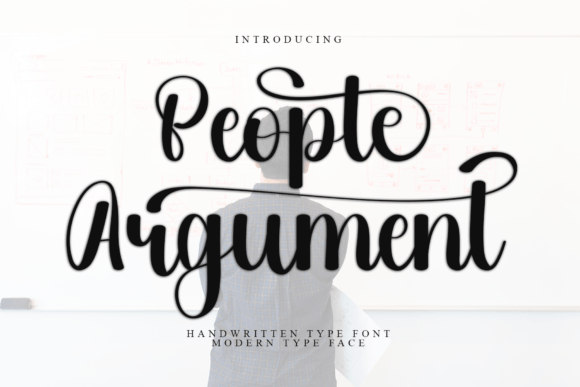
People Argument isn’t just another brush script—it’s a carefully considered handwritten typeface built for visibility, personality, and purpose. Designed with intentional variation in stroke weight, rhythm, and letter spacing, it avoids the common pitfalls of overly decorative scripts: illegibility at small sizes, stiffness in digital interfaces, or inconsistency across weights and characters. What sets People Argument apart is its grounded confidence—not flamboyant, not restrained, but expressive with intention.
What Makes People Argument Distinctive?
At its core, People Argument is a single-weight, uppercase-only font that leans into the natural irregularities of hand-drawn lettering without sacrificing structural coherence. Each glyph reflects subtle variations in pressure and direction—mirroring how a skilled hand might move across paper—but those variations are calibrated, not random. The capital letters feature open counters, generous x-height equivalents (despite being all-caps), and slightly widened proportions that enhance readability in display settings.
Unlike many brush fonts that rely on exaggerated flourishes or tight kerning to feel “artistic,” People Argument uses negative space thoughtfully. Its letterforms breathe, especially in headlines or short phrases where legibility and impact matter most. It doesn’t try to mimic calligraphy tools—it interprets their spirit through digital precision.
Practical Strengths in Real-World Use
People Argument excels where visual tone and brand voice intersect: packaging headers, social media banners, editorial pull quotes, podcast cover art, and boutique website hero sections. Its strength lies in contrast—pairing well with clean sans-serifs like Inter, Poppins, or even classic serifs like Merriweather for balance. Because it’s all-caps and lacks lowercase alternates or ligatures, it encourages concise, impactful messaging. You won’t use it for body text—and it’s not meant to be.
In testing across devices, People Argument holds up reliably at 36px and above on screens, and scales cleanly in print up to 72pt without losing nuance. Its vector outlines remain crisp in SVG exports, and it embeds cleanly in modern web projects using @font-face declarations. No OpenType features complicate implementation; it’s straightforward to deploy and maintain.
Consistency and Craftsmanship
The font includes full Latin-1 support (covering English, Spanish, French, German, Portuguese, and more), plus standard punctuation and numerals. Every character was drawn by hand first, then digitized and refined—not traced or auto-generated. This shows in the organic flow between letters like “A” and “V”, or the way “R” and “T” anchor lines without visual tension. There’s no artificial randomness: spacing is tuned, not randomized. That consistency supports professionalism—especially important when representing a business, course, or creative product.
That said, People Argument isn’t designed for multilingual expansion beyond Western European languages. It doesn’t include Cyrillic, Greek, or extended diacritics. If your audience spans multiple language groups or requires robust localization, you’ll need fallback options or complementary fonts.
Who Benefits Most—and When?
Small business owners launching a lifestyle brand—think ceramic studios, independent bookshops, or wellness coaches—often find People Argument resonates with audiences seeking authenticity without pretension. Its warmth feels human, but its structure keeps it from drifting into “craft fair cliché.” For example, a local coffee roaster used People Argument for their seasonal blend label headline (“SUMMER ROAST”), pairing it with a light sans-serif for origin details. The result felt artisanal yet polished—neither too casual nor overdesigned.
Freelance designers and marketers appreciate how quickly People Argument establishes mood. One branding consultant reported using it across three client projects in a single month: a nonprofit’s campaign banner (“STAND WITH US”), a yoga studio’s workshop poster (“BREATHE DEEPER”), and a newsletter header for an education newsletter (“THINK CLEARLY”). In each case, the font contributed to tone without requiring custom illustration or time-intensive lettering.
Educators developing presentation decks or course materials also benefit—particularly when aiming to signal approachability alongside authority. A university extension instructor replaced generic script fonts in her slide titles with People Argument and noted improved student engagement during synchronous sessions. The font didn’t distract, but it did invite attention.
Limitations to Acknowledge
Because People Argument is intentionally minimal—no italics, no bold variants, no lowercase—it doesn’t support typographic hierarchy within a single font family. You’ll need at least one strong companion font to handle subheads, captions, or interface labels. Also, while its rhythm works beautifully in short bursts, extended use (e.g., full-page quotes or multi-line testimonials) can fatigue the eye. It’s best deployed selectively—not as a system font, but as a deliberate accent.
Its all-caps nature may pose accessibility considerations in some contexts. While WCAG doesn’t prohibit all-caps usage outright, prolonged all-caps text reduces scannability for many readers, including those with dyslexia or low vision. Best practice: reserve People Argument for headlines, logos, or short emphasis phrases—not navigation labels or paragraph leads.
Integration and Workflow Fit
People Argument works seamlessly in Figma, Adobe Creative Cloud, and modern CSS environments. Its file size is modest (~45 KB WOFF2), so web performance impact is negligible. No complex licensing tiers or subscription walls—it’s available as a one-time purchase with commercial use rights, including merchandise and SaaS interfaces.
For teams using design systems, People Argument fits cleanly as a “display only” asset. Document its intended use cases clearly: “Use for primary headlines ≤ 4 words; pair with [X] sans-serif for supporting text.” That kind of clarity prevents misuse and preserves its impact over time.
A Final Observation
Good typography serves communication—not decoration. People Argument succeeds because it understands that boundary. It doesn’t shout. It doesn’t apologize. It occupies a narrow but valuable lane: expressive enough to convey individuality, structured enough to earn trust. It won’t replace your workhorse sans-serif. But when you need a voice that feels both crafted and confident—whether for a logo lockup, a keynote slide, or a limited-edition poster—People Argument delivers quiet authority without overreach.
If your work involves balancing creativity with clarity—and if your audience responds to sincerity over slickness—People Argument deserves a place in your toolkit. Not as a default, but as a considered choice. And in today’s landscape of algorithm-driven templates and AI-generated visuals, that kind of intentionality matters.