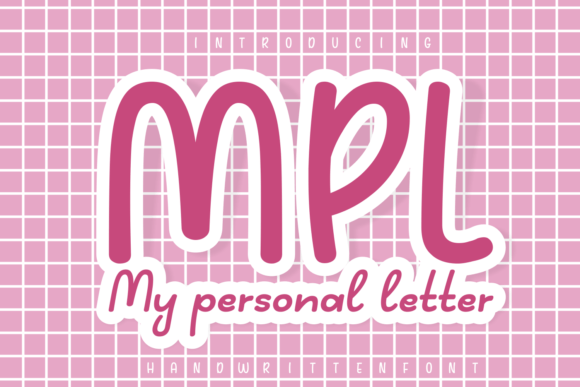
My Personal Letter: A Script Font That Feels Like a Thought Made Visible
If you’ve ever paused mid-design to ask, “Does this feel *human*?”—you’re not overthinking. You’re sensing the quiet gap between polished perfection and genuine connection. That’s where My Personal Letter steps in: not as another decorative font, but as a script typeface that behaves like a trusted collaborator—soft-spoken yet confident, personal yet professional.
It’s hand-crafted with intention—not just drawn, but *felt*. Each curve echoes the slight hesitation of ink meeting paper, the gentle swell of a lowercase ‘o’, the subtle lift at the end of a ‘t’. It doesn’t mimic handwriting perfectly; it captures its warmth, its rhythm, its quiet authenticity. And because it’s designed for versatility—not just aesthetics—it works where many script fonts falter: in real workflows, across real devices, and inside real deadlines.
Where It Fits Without Fitting In
You won’t find My Personal Letter shouting from a billboard or anchoring a corporate logo—but you’ll spot it in the places where tone matters more than scale. Think of it as the quiet voice behind the message, not the megaphone.
A freelance educator uses it in printable worksheets for middle-school science—replacing sterile sans-serifs with something that says, “This isn’t just facts; it’s an invitation to wonder.” The curves soften the pressure of learning. Students subconsciously relax. Engagement rises—not because the font is “fun,” but because it feels *safe* to engage with.
A small-batch candle maker adds it to product labels and thank-you cards—not as a gimmick, but as continuity. When someone opens their box, the scent hits first, then the texture of the label, then the gentle flow of My Personal Letter spelling out “Lavender & Rain.” It doesn’t distract. It deepens. That’s how branding becomes belonging.
When Simplicity Isn’t Just Stylistic—It’s Strategic
Here’s what users consistently notice: My Personal Letter performs best when clarity and character share equal weight. It shines in contexts where readability can’t be sacrificed—but neither can personality.
- Digital newsletters: Used for subject lines or short pull quotes (not body text), it gives email campaigns a tactile, human signature—especially effective for lifestyle bloggers, therapists, or wellness coaches whose audiences crave sincerity over slickness.
- Classroom slides and handouts: Teachers use it for titles, activity headers, or reflection prompts. One high school English teacher told us, “My students don’t see ‘font’—they see *me*, writing something just for them.”
- Wedding stationery & small-event invites: Not for full paragraphs, but for names, dates, or short phrases (“Join us,” “Forever begins here”). Its petite proportions mean it fits gracefully on RSVP cards and digital save-the-dates without crowding or shrinking.
- Instagram Stories and Canva social posts: Paired with clean sans-serif body text, it adds warmth to quotes, announcements, or limited-time offers—without triggering accessibility warnings or rendering poorly on mobile.
What It Doesn’t Do (And Why That Matters)
My Personal Letter isn’t built for dense paragraphs, legal disclaimers, or multilingual layouts with extended Latin or Cyrillic characters. It doesn’t include stylistic alternates, swashes, or ligatures—and that’s by design. Its strength lies in restraint. Users who try to force it into roles it wasn’t shaped for often report visual fatigue or inconsistent spacing. That’s not a flaw; it’s fidelity to purpose.
Before downloading or licensing it, ask yourself: Is this about adding charm—or supporting meaning? If your goal is to highlight a single line of emotional resonance—a tagline, a student’s name on a certificate, the title of a memoir chapter—My Personal Letter delivers quietly and reliably. If you need heavy typographic flexibility or broad language support, pair it thoughtfully with a neutral companion font (like Lora, Inter, or Source Serif) instead of stretching it beyond its natural range.
Real Decisions, Real Outcomes
Consider Sarah, a nutritionist launching her first online course. She tested two versions of her sales page header: one in a bold geometric sans, one in My Personal Letter. Conversion didn’t spike dramatically—but survey responses did. “Felt like she was talking to me, not selling to me,” wrote one registrant. Another said, “I trusted her before I even read the first module.” That’s the outcome—not flash, but resonance.
Or take Marco, a graphic designer building brand kits for local artisans. He includes My Personal Letter as an optional accent font—not as the hero, but as the “voice” layer. Clients love having a tool that helps them say, “This is handmade. This is thoughtful. This is *mine*”—without needing custom illustration or copywriting.
Even educators use it pragmatically: not for grading rubrics, but for personalized feedback stamps (“You nailed this!”), classroom job charts, or student-led presentation titles. It signals care without condescension—because it looks handwritten, but never childish.
Getting Started—Without Overcomplicating It
You don’t need advanced typography knowledge to use My Personal Letter well. Start small: pick one recurring use case in your current workflow—maybe email subject lines, worksheet headers, or Instagram story text—and test it there for two weeks. Notice how people respond—not just visually, but emotionally and behaviorally.
Download options vary: some platforms offer it as part of a curated font bundle; others license it individually. Check file formats (OTF works reliably across Adobe apps and modern web tools); confirm licensing covers your intended use (personal, commercial, or web-embedding). Most importantly—preview it at actual size. What reads beautifully at 48pt may tighten awkwardly at 16pt. Trust your eyes over the specimen sheet.
And remember: fonts don’t build connection alone. My Personal Letter works because it meets people where they are—in moments that matter quietly: a student’s first A+, a client’s “yes,” a reader pausing mid-scroll because the words felt like they were written just for them.
That’s not magic. It’s intention—made visible, one letter at a time.