Morning Sunflower
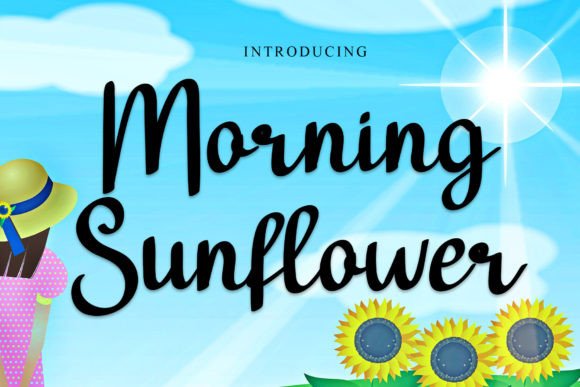
There’s a quiet magic in handwriting that no algorithm can fully replicate — the subtle lift of a pen, the gentle swell of a curve, the organic pause between strokes. Morning Sunflower captures that magic with remarkable authenticity. It’s not just another script font; it’s a carefully crafted typeface designed to feel like it was written by hand at sunrise — warm, unhurried, and full of intention. Whether you’re drafting wedding invitations for a couple who values sincerity over spectacle, designing a boutique logo that whispers rather than shouts, or crafting a billboard where personality must land in under three seconds, Morning Sunflower delivers presence without pretense.
Why Designers Reach for Morning Sunflower (and Why Some Regret It Later)
Many creators choose Morning Sunflower because it promises elegance, warmth, and distinction — all real strengths. Its baseline variability mimics natural handwriting: letters sit at slightly different heights, creating rhythm and breath. Swashes flow gracefully, not mechanically. And with PUA (Private Use Area) encoding, accessing alternate glyphs and flourishes is intuitive — no complex OpenType panels required. That accessibility makes it especially appealing to beginners and time-pressed professionals alike.
Yet some users find their final designs falling short — not because the font is flawed, but because they overlooked how context shapes performance. A common misstep? Assuming Morning Sunflower works equally well at every size and medium. Its delicate terminals and fine hairlines shine beautifully at 24–48 pt on high-resolution print, but shrink it to 14 pt for a mobile menu or stretch it across a sun-drenched outdoor billboard, and those same details blur or vanish. The result isn’t charm — it’s illegibility.
The “Too Much Too Soon” Trap
Another frequent oversight is overusing swashes and alternates without hierarchy. Yes, Morning Sunflower includes dozens of elegant ligatures and entry/exit strokes — but scattering them across every word dilutes impact. Imagine a wedding invitation where *every* letter in “Mr. & Mrs. Chen” has a dramatic flourish. Instead of feeling luxurious, it feels cluttered — like trying to hear a violin solo in a symphony where every instrument plays fortissimo.
A better approach? Reserve swashes for key moments: the first letter of a name, the closing “love” in a salutation, or the single word “forever” in a vow card. Let the rest breathe in the clean, unadorned version of the font. This contrast doesn’t diminish the font’s character — it deepens it.
Compatibility Isn’t Guaranteed — Even With PUA
PUA encoding simplifies glyph access in design apps like Adobe Illustrator or Affinity Designer — but it doesn’t solve cross-platform issues. If you’re sharing editable files with a client or collaborator using older software, free alternatives, or web-based tools (like Canva), those custom swashes may not render at all. You might see placeholder boxes, default glyphs, or even crashes.
Before committing to Morning Sunflower for a collaborative project, test it in your actual workflow: open the file in the version of software your team uses, export a PDF with embedded fonts, and preview it on a device without the font installed. Better yet — generate static versions (PNG/SVG) of critical elements early, so visual integrity stays intact regardless of environment.
Don’t Skip the License Check — Especially for Logos and Merch
This one trips up freelancers and small business owners regularly. Morning Sunflower is often sold with desktop licenses — perfect for invitations, social graphics, or internal presentations. But if you’re embedding it into a website via @font-face, printing it on T-shirts, or locking it into a mobile app interface, you’ll likely need an extended license. Using a desktop-only version in these contexts isn’t just a legal risk; it can cause rendering inconsistencies, missing characters, or unexpected substitutions when fonts fail to load.
Always read the license terms *before* purchase — not after. Reputable sellers clearly outline usage rights. If the page says “web use requires separate license,” don’t assume “it’ll probably work.” It might — until it doesn’t, mid-campaign.
What to Test Before You Commit
Before buying or downloading Morning Sunflower, run these quick checks:
- Try the free trial (if offered) — paste real copy, not lorem ipsum. Type your client’s name, a tagline, and a short sentence. Does “Sarah & James” look balanced? Does “Est. 2025” align cleanly?
- Zoom out to 25% — simulate how it reads from across a room or on a phone screen. If the rhythm collapses or spacing feels uneven, consider pairing it with a strong sans-serif for body text instead of forcing it everywhere.
- Check kerning pairs manually — some script fonts struggle with “To”, “We”, or “The”. Adjust tracking if needed, but avoid over-compensating with excessive letter-spacing, which kills the handwritten illusion.
- Verify language support — while Morning Sunflower covers English, Western European, and many accented characters, it may not include Cyrillic, Greek, or Vietnamese diacritics. If your audience spans multiple languages, confirm coverage before finalizing.
When Simplicity Serves Better Than Swashes
Not every project needs ornamentation — and that’s where Morning Sunflower quietly excels. Its standard weight, without flourishes, retains warmth and individuality while offering surprising versatility. Try it for:
- Handwritten-style email headers (with light tracking and generous line height)
- Minimalist product labels where texture matters more than decoration
- Chalkboard-style café menus — especially when paired with a soft, neutral sans-serif for prices and descriptions
- Personalized thank-you notes printed on textured paper — where the font’s natural variation echoes the paper’s grain
In these cases, restraint isn’t limitation — it’s clarity. You’re not hiding the font’s beauty; you’re letting its honesty speak plainly.
A Final Note on Intention
Morning Sunflower invites intentionality. It asks you to slow down, to consider not just what you’re saying, but how it will be felt. That’s why it resonates so deeply in moments meant to last — weddings, anniversaries, brand launches, personal milestones. When used thoughtfully, it doesn’t just decorate words — it honors them.
So before you add that final swash or scale it for a banner, pause. Ask: Does this choice serve the message — or just the moment? With Morning Sunflower, the most beautiful results aren’t the flashiest. They’re the ones that feel inevitable.