Mansions: A Handwritten Signature Script Built for Authentic Personal Branding
When selecting a signature-style font for professional use—especially in photography, wedding stationery, or personal branding—the goal isn’t just visual appeal. It’s about conveying trust, individuality, and consistency across touchpoints. Mansions is a handwritten signature script designed with that intention in mind: not as a decorative flourish, but as a functional, expressive tool for professionals who rely on authenticity in their visual identity.
What Sets Mansions Apart from Other Signature Scripts
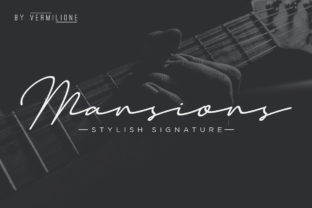
At its core, Mansions is built around natural flow—not rigid calligraphy, not exaggerated swashes, but the subtle rhythm of confident handwriting. Its letterforms include slight variations in stroke weight, organic entry and exit strokes, and intentional imperfections that avoid the sterile uniformity found in many digitally rendered scripts. This gives it an approachable yet polished character—neither overly formal nor casually messy.
Unlike many signature fonts that offer only one version per letter, Mansions includes a diverse set of alternates. These aren’t just stylistic extras; they’re functionally useful. For example, alternate lowercase “a” and “g” forms allow for variation when repeating the same name across multiple projects—say, a photographer’s watermark on hundreds of images, or a designer’s monogram across social media assets. That built-in flexibility helps avoid visual fatigue without requiring manual editing or external tools.
Fitting Into Real-World Workflows
Photographers often need a discreet but legible watermark that doesn’t distract from the image—but still reinforces brand recognition. Mansions works well here because its spacing and x-height are calibrated for readability at smaller sizes, while its natural slant and fluid connections retain personality even when scaled down. In contrast, some script fonts collapse visually at 12–16px, losing legibility or appearing cramped.
For wedding invitation designers, Mansions offers a balance between elegance and warmth. It avoids the stiff formality of copperplate-inspired scripts and the informality of casual brush fonts—making it adaptable for both modern minimalist suites and vintage-inspired layouts. Its consistent baseline alignment also simplifies layout work, especially when pairing with serif or sans-serif body text.
Comparing Strengths and Tradeoffs
Signature fonts fall broadly into three categories: formal calligraphic, casual brush-based, and naturalistic handwritten. Mansions sits firmly in the third group—and that positioning shapes its practical strengths and limitations.
- Strength: High reusability across formats—from digital watermarks to printed foil-stamped stationery—without feeling repetitive.
- Strength: Designed with typographic integrity: consistent spacing, logical kerning pairs, and OpenType features that support automatic ligatures and contextual alternates.
- Tradeoff: Not ideal for long-form text. Like most signature scripts, it’s intended for short phrases, names, or headlines—not paragraphs.
- Tradeoff: Less suitable for brands aiming for bold, high-contrast impact (e.g., luxury fashion logos where sharp angles and dramatic contrast dominate).
Some alternatives prioritize extreme customization—like fonts with dozens of swash variants or layered textures—but those often require deeper design expertise to use effectively. Mansions prioritizes usability: it delivers expressive variation without demanding advanced OpenType knowledge. You don’t need to toggle features manually to get good results; the default set already balances rhythm and distinction.
When Mansions Is the Right Fit
Mansions tends to be strongest in contexts where human connection matters more than technical precision. Consider it when:
- You’re a portrait or wedding photographer building a cohesive brand identity—and want your signature to feel like part of the story, not an afterthought.
- You design invitations, business cards, or client-facing collateral where tone and personality influence perception as much as content does.
- You’ve tried other signature fonts but found them either too generic (repeating the same “r” or “t” across every use) or too ornate (distracting from the subject or message).
- You value consistency across platforms: same font working cleanly on Instagram bios, email signatures, printed thank-you notes, and website headers.
A real-world example: A boutique wedding photographer used Mansions for her logo lockup, her watermark, and the couple’s names on digital proofs. Because the alternates prevented repetition, clients noticed the signature as distinctive—not mechanical—even after seeing it dozens of times. That subtle consistency reinforced professionalism without sacrificing warmth.
When Another Option Might Be Better
Not every project benefits from a naturalistic signature script. If your brand voice leans toward structured minimalism—think architecture firms, tech consultants, or editorial publications—Mansions may feel too soft or informal. In those cases, a restrained sans-serif with custom letter-spacing or a geometric monogram might communicate clarity and authority more directly.
Similarly, if you need multilingual support beyond basic Latin characters (e.g., extended diacritics for French or Romanian, Cyrillic coverage), Mansions’s current scope may require supplementation. It’s optimized for English-language personal branding—not global enterprise applications.
And while Mansions includes thoughtful alternates, it’s not a variable font. Designers who rely heavily on fine-tuned weight or width adjustments mid-project may find themselves layering styles manually rather than using a single adaptive file.
Evaluating Long-Term Value
One reason Mansions stands out among signature fonts is how it handles longevity. Many scripts age quickly—either by following fleeting trends (e.g., ultra-thin hairlines popular in 2018) or by relying on gimmicks (like forced texture overlays). Mansions avoids both. Its proportions, contrast, and rhythm align with enduring typographic principles: moderate stress, open counters, and balanced negative space.
That makes it less likely to feel dated in two or five years. More importantly, it means the font adapts as your brand evolves. A photographer starting with simple Instagram posts can use Mansions for early watermarks—and later scale it to branded slide decks, client welcome kits, or even embroidered studio signage without visual dissonance.
Making an Informed Choice
Choosing a signature font isn’t just about aesthetics—it’s about selecting a tool that supports your workflow, reflects your voice, and scales with your growth. Mansions excels when those priorities center on authenticity, adaptability, and quiet confidence.
Before committing, test it in your actual environment: apply it to a recent photo as a watermark at 5% opacity, type your full name in several sizes, and check how it pairs with your current body font. Does it feel like an extension of your voice—or does it demand attention for the wrong reasons?
If you value a script that feels hand-drawn but remains technically reliable—if you want variation without complexity—if your work lives at the intersection of artistry and professionalism—then Mansions warrants serious consideration. It doesn’t try to be everything. Instead, it focuses on doing one thing exceptionally well: giving your name, your brand, your craft a signature that feels unmistakably yours.