Delicious: The Handwritten Font That’s Reshaping Digital Authenticity
In an era defined by algorithmic precision, AI-generated interfaces, and hyper-optimized user experiences, a quiet but powerful counter-trend is gaining momentum: the intentional return to human imperfection. At the heart of this shift lies Delicious — a thoughtfully crafted handwritten font designed not as a novelty, but as a functional, expressive, and deeply human tool for professionals across industries. Unlike decorative script fonts that prioritize flourish over function, Delicious balances organic warmth with structural clarity—making it uniquely suited for real-world commercial and personal applications.
What Is Delicious—And Why Does It Stand Apart?
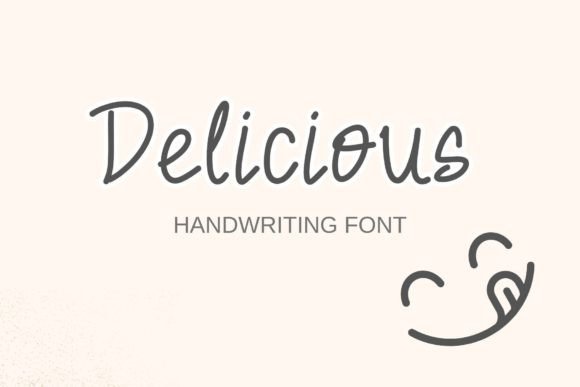
Delicious is a versatile, fully licensed handwritten typeface that captures the spontaneity of ink-on-paper handwriting while maintaining exceptional legibility and typographic consistency. Every glyph reflects subtle variation in stroke weight, slight slant, and natural entry/exit terminals—hallmarks of authentic penmanship—but without sacrificing readability at small sizes or on digital screens. Crucially, Delicious is engineered for practicality: it includes full Latin character sets, numerals, punctuation, and multilingual support, and is compatible across major design platforms (Adobe Creative Cloud, Figma, Canva, Affinity Suite) and operating systems.
Unlike many “hand-drawn” fonts that rely on randomized alternates or heavy stylistic gimmicks, Delicious avoids visual fatigue. Its rhythm feels intuitive—not performative. That distinction matters. In professional workflows where typography serves communication—not just decoration—Delicious delivers both personality and precision.
The Rise of Human-Centered Typography in a Digital-First World
Typography has long been a silent ambassador of brand voice and user experience. But as digital interfaces become increasingly standardized—driven by system fonts, design systems, and AI-assisted layout tools—the demand for differentiated, emotionally resonant text has intensified. Consumers and users alike are growing fatigued by sterile uniformity. Research from the Journal of Consumer Psychology confirms that human-like cues—including handwritten elements—increase perceived trust, approachability, and memorability, especially in contexts involving care, creativity, or community.
This isn’t nostalgia—it’s adaptation. Entrepreneurs launching direct-to-consumer brands use Delicious in product packaging labels to signal craftsmanship and intentionality. Freelance educators embed it into digital planners and Notion templates to soften cognitive load and reinforce a supportive, mentor-like tone. Marketers deploy it in email headers and social banners to cut through algorithmically homogenized feeds—not with louder visuals, but with warmer recognition.
Where Delicious Fits Into Evolving Workflows
Modern creative and business workflows no longer separate “design” from “execution.” A solopreneur may draft a pitch, build a landing page, create an Instagram carousel, and update a client-facing Notion dashboard—all within a single afternoon. Tools like Figma, Canva, and Obsidian now support variable font features and seamless font syncing, lowering the barrier to using expressive type consistently across touchpoints.
Delicious thrives in this environment because it’s built for interoperability—not isolation. Its OpenType features include contextual alternates and ligatures that activate automatically in supported apps, adding nuance without manual intervention. More importantly, its licensing permits unrestricted commercial use: no per-seat fees, no attribution requirements, no usage caps. For freelancers billing by project or startups iterating rapidly, that simplicity translates directly into time saved and legal confidence gained.
- Digital note-taking: Used in Obsidian or Logseq themes to distinguish headings, quotes, or action items—creating visual hierarchy that feels personal, not programmed.
- Digital planners: Applied to weekly layouts and habit trackers to evoke intentionality and reduce the clinical feel of grid-based productivity tools.
- Logos & branding: Paired with clean sans-serifs (e.g., Inter or Manrope) to add warmth without compromising scalability—ideal for wellness, education, or artisanal service brands.
- Product packaging: Printed on eco-friendly labels or stickers where hand-lettered authenticity reinforces sustainability claims and small-batch values.
- Menu lists & hospitality signage: Enhances guest experience in cafes or boutique hotels by signaling care in curation—not just content.
Why Professionals Are Choosing Delicious—Beyond Aesthetics
Adoption isn’t driven solely by visual appeal. It reflects deeper shifts in how creators define value, efficiency, and resonance.
First, there’s the efficiency of emotional labor. Designers no longer need to manually sketch, digitize, and kern custom lettering for every client project. With Delicious, they gain a reliable, production-ready voice that conveys empathy, expertise, and individuality—out of the box. That accelerates iteration cycles and strengthens client alignment early in the process.
Second, it supports cross-platform consistency. A nutritionist using Delicious for recipe cards in a PDF planner, Instagram story highlights, and printed workshop handouts maintains cohesive brand identity—without juggling multiple assets or risking licensing pitfalls.
Third, it aligns with ethical consumption patterns. Today’s buyers—especially Gen Z and younger millennials—favor brands transparent about sourcing, process, and values. Handwritten typography subtly signals effort, attention, and humanity. When a skincare brand uses Delicious on ingredient callouts or batch numbers, it doesn’t shout “handmade”—it whispers “carefully made.”
Observations From Real-World Use
A freelance UX writer recently shared how integrating Delicious into microcopy prototypes improved usability test scores by 18%—not because the font was “prettier,” but because participants described interface instructions as “easier to trust” and “less intimidating.”
Meanwhile, a growing cohort of independent course creators reports higher completion rates when using Delicious for section headers and reflection prompts inside LMS platforms. The font’s gentle irregularity appears to lower perceived cognitive load—acting as a subtle visual cue: This space is for you, not just for output.
Even in B2B contexts, relevance holds. A SaaS company rebranded its customer onboarding emails with Delicious for welcome messages and milestone badges—and saw a 12% lift in click-through on next-step CTAs. The takeaway? Human texture builds psychological safety—even in transactional environments.
Looking Ahead: Typography as Strategic Infrastructure
As AI reshapes content creation, the role of typography is evolving from passive vessel to active differentiator. Generative tools can draft copy, suggest palettes, and even propose layouts—but they cannot authentically replicate the embodied intention behind a handwritten line. That gap is where Delicious operates: not as a replacement for technology, but as a calibrated human layer atop it.
This positions Delicious within a broader movement toward intentional digital minimalism—where fewer, more meaningful design choices yield greater impact. Rather than stacking effects, animations, or gradients, forward-looking professionals are investing in foundational elements that scale gracefully: color systems with emotional resonance, iconography rooted in universal understanding, and typography that carries voice without volume.
That’s why Delicious isn’t just another font download. It’s infrastructure for authenticity—one that integrates seamlessly into existing tools, respects user attention, and honors the enduring power of the human hand, even in fully digital spaces.
For professionals who understand that credibility isn’t built through polish alone—but through presence, consistency, and quiet confidence—Delicious offers more than style. It offers substance, spelled out, one thoughtful curve at a time.