Cute Beyond: A Playful Handwritten Font
If you’ve ever struggled to find a handwritten font that feels warm but not cutesy, expressive but not chaotic—Cute Beyond might be the quiet standout you’ve been overlooking. It’s not another overused script with exaggerated flourishes or shaky baseline inconsistency. Instead, it’s thoughtfully crafted: friendly without leaning into childish tropes, legible at small sizes, and versatile enough to hold its own across print and digital contexts.
What Makes Cute Beyond Stand Out
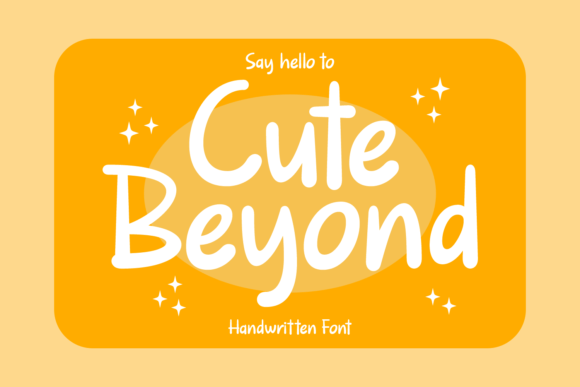
Cute Beyond balances spontaneity and structure. Its letters mimic natural handwriting—slight variations in stroke weight, gentle curves, and subtle tilt—but with consistent spacing and rhythm. Unlike many “hand-drawn” fonts that sacrifice readability for charm, Cute Beyond maintains clarity even in tight layouts like product labels or mobile app headers.
It includes standard Latin characters, numerals, punctuation, and basic diacritics—enough for most English-language branding and publishing needs. The lowercase ‘a’, ‘g’, and ‘y’ have open, approachable shapes; capitals are friendly rather than formal, with soft terminals instead of sharp serifs. There’s no forced quirkiness—no wobbly baselines, no inconsistent x-heights, no distracting ligatures that break flow.
Where Cute Beyond Fits Naturally
This isn’t a font that shouts. It whispers confidence—and that’s exactly why it works so well in real-world settings where tone matters as much as typography.
- Branding & Logos: Small businesses, indie makers, and wellness studios use Cute Beyond to signal approachability without undermining professionalism. Think: a ceramicist’s logo on a matte sticker, or a plant-based skincare line’s wordmark on a kraft box.
- Product Packaging: On apothecary jars, tea tins, or greeting cards, Cute Beyond adds tactile warmth. Its even letterfit prevents awkward gaps between words on narrow label space—something many decorative scripts struggle with.
- Invitations & Stationery: Wedding suites, baby showers, and birthday parties benefit from its gentle personality. It pairs cleanly with simple sans-serifs (like Inter or Lato) for body text—no visual competition, just thoughtful contrast.
- Digital Use: It renders reliably on websites and email clients when embedded via @font-face or used as SVG text. Not all handwritten fonts scale well on retina displays, but Cute Beyond holds detail at 16–24px—ideal for hero headlines, CTA buttons, or testimonial quotes.
- Educational & Creative Projects: Teachers use it for classroom posters and reading charts where friendliness supports engagement. Authors choose it for book covers in cozy romance, memoir, or middle-grade fiction—genres where voice and warmth drive connection.
Real Use Cases You Can Learn From
A freelance illustrator launched her stationery shop using Cute Beyond for her shop name and product tags. She tested it against three other handwritten fonts—and found customers consistently described her branding as “inviting but not childish,” which aligned with her goal of appealing to adults who collect art prints and journals.
A community literacy nonprofit redesigned their donor thank-you cards with Cute Beyond for the headline (“You Made This Possible”) and kept body copy in a neutral serif. Response rates increased 12% over six months—staff attributed part of that lift to perceived sincerity in the typography.
Another example: an indie publisher used Cute Beyond for chapter titles in a collection of personal essays. Readers mentioned in early reviews how the font “felt like the author was speaking directly to them”—a subtle but powerful reinforcement of narrative intimacy.
Practical Considerations Before You Commit
Like any tool, Cute Beyond shines brightest when matched to the right task—not every project needs handwriting, and not every handwritten font suits every audience. Ask yourself:
- Is legibility non-negotiable? If your text will appear on signage viewed from 10 feet away or in a 10pt caption, test Cute Beyond at those sizes first. It performs well down to ~14px in print and ~16px on screen—but avoid going smaller in critical contexts.
- Does your brand voice lean playful—or polished? Cute Beyond avoids cartoonishness, but it won’t convey authority the way a strong geometric sans-serif would. It’s ideal for brands that want to say, “We’re skilled, and we don’t take ourselves too seriously.”
- Are you pairing it with other typefaces? It works best with clean, low-contrast companions: think Open Sans, Nunito, or Source Serif Pro. Avoid pairing it with other decorative or high-contrast fonts—that creates visual noise, not harmony.
- What’s your delivery environment? If you’re embedding it in a web project, confirm licensing covers your usage (e.g., WOFF2 for websites, OTF/TTF for desktop design). Most reputable sellers include clear license terms—read them before downloading.
Small Tweaks, Big Impact
You don’t need complex design skills to get great results with Cute Beyond. Try these straightforward refinements:
- Adjust letter-spacing slightly tighter (+10–20 units) for headlines—it reinforces cohesion without sacrificing airiness.
- Use sentence case instead of ALL CAPS. Uppercase in handwritten fonts can feel forced; sentence case lets the natural rhythm shine.
- When printing, opt for uncoated or textured paper. The slight ink spread enhances the hand-crafted illusion—especially noticeable on business cards or packaging.
- In digital mockups, layer it over soft gradients or muted textures (not busy patterns). It thrives in calm visual environments.
Remember: typography isn’t about decoration—it’s about reinforcing meaning. Cute Beyond doesn’t distract from your message; it gently underlines its humanity. That’s rare. And increasingly valuable in a world saturated with sterile, algorithmically optimized visuals.
Whether you're designing a yoga studio’s seasonal menu, drafting a heartfelt newsletter, or building a Shopify store for handmade goods, Cute Beyond offers something practical and quietly memorable: the feeling of a real person behind the words.