Cabbage
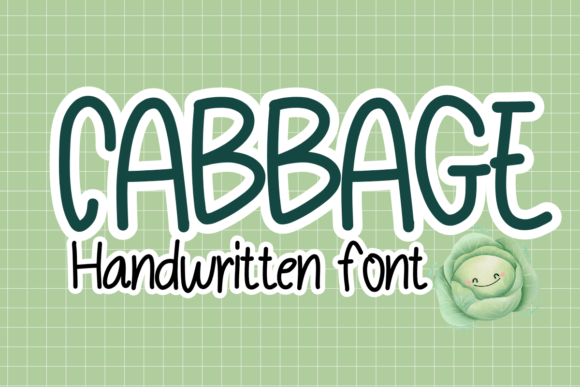
There’s something quietly magnetic about Cabbage: a friendly, hand-drawn font that feels like it was sketched during a cozy afternoon with tea and a well-loved notebook. It’s not flashy or overly stylized — just warm, legible, and full of gentle personality. That’s why so many people reach for Cabbage when they want handwritten charm without sacrificing readability: for journal entries, greeting cards, social media quotes, or even custom mugs and stationery. But while its appeal is immediate, how you use it — and what you assume about it — can make the difference between a design that resonates and one that falls flat.
It’s handwritten — but not *all* handwriting works the same way
One common misstep is assuming that because Cabbage looks casual, it automatically fits every “handwritten” use case. In reality, Cabbage has a specific rhythm: moderate contrast, open letterforms, and consistent baseline alignment. That makes it great for short bursts of text — like a tagline on a tote bag or a heartfelt note inside a birthday card — but less ideal for long paragraphs or dense body copy. You’ll see this mismatch most often in blog headers paired with tiny Cabbage subheadings that vanish at small sizes, or on product packaging where fine details blur in print.
If your goal is readability at scale — say, on a banner viewed from across a room or a printed flyer handed out at an event — test Cabbage at 3–4 different sizes *before* finalizing layouts. Better yet: pair it intentionally. Use Cabbage for headlines and names, then switch to a clean, highly legible sans serif (like Inter or Open Sans) for supporting text. This isn’t a compromise — it’s smart visual hierarchy.
Free ≠ ready-to-use everywhere
You’ll find Cabbage listed on several free font sites — but not all versions are equal. Some downloads lack full character sets (missing accented letters, punctuation variants, or numerals), while others come without proper licensing for commercial use. That’s especially risky if you’re designing for a client, selling branded merchandise, or posting content on social platforms where brands increasingly enforce font licensing through automated tools.
Before downloading, check two things: first, whether the source links back to the original designer (often via Google Fonts or the creator’s site); second, whether the license explicitly permits your intended use — personal, commercial, or web-embedded. The official version of Cabbage is available on Google Fonts under the Open Font License, which covers most personal and commercial projects — including web use via @import or . If you’re ordering physical goods (like mugs or shirts), confirm with your print provider whether they accept Google Fonts or require desktop-licensed files.
Don’t overlook spacing — especially kerning and line height
Cabbage’s charm lives in its organic flow, but that also means default spacing settings won’t always serve it well. Automatic kerning in design apps sometimes over-corrects or under-corrects letter pairs like “To”, “We”, or “Av”. And because the font sits slightly higher on the baseline than many system fonts, line height that looks fine with Arial or Helvetica can feel cramped or disjointed with Cabbage.
A simple fix? Manually adjust tracking by +5 to +10 units for headings, and increase line height to at least 1.4–1.6 for any multi-line text block. In CSS, try line-height: 1.5; and letter-spacing: 0.5px; as safe starting points — then step back and read it aloud. If it feels bumpy or breathless, give it more air.
It’s expressive — but expression needs context
Using Cabbage everywhere — on a law firm’s website, a medical brochure, or a formal invitation — can unintentionally undercut tone and credibility. Handwritten fonts communicate approachability and informality. That’s perfect for a local bakery’s Instagram story announcing weekend specials, but less aligned with a financial advisor’s annual report summary.
Ask yourself: *What feeling should this piece evoke — and does Cabbage support that, or distract from it?* A teacher creating classroom posters might use Cabbage for student-facing titles (“Our Science Fair Projects!”) but choose a structured, accessible font for instructions and rubrics. A freelance designer pitching to a tech startup might preview a brand concept using Cabbage for a playful accent logo — but keep navigation, buttons, and body text in something neutral and scalable.
Printing? Test early — and test physically
Digital screens render Cabbage beautifully: smooth curves, soft edges, subtle texture. Print is less forgiving. On uncoated paper or lower-DPI printers, fine strokes may fill in, and delicate gaps between letters can close up. You’ll notice this most with light-weight versions or smaller point sizes.
Before sending anything to press, print a real sample — not just a PDF preview. Try it on the actual paper stock you’ll use. If strokes look muddy or spacing collapses, bump the size up by 2–4 points, or switch to the medium weight (if available). Many designers skip this step and end up reordering business cards or wedding programs — a small delay that costs time and trust.
Pairing isn’t optional — it’s essential
Using Cabbage solo — no companion font — limits flexibility and often leads to visual fatigue. Its personality shines brightest when balanced against something grounded: a sturdy sans serif, a classic serif, or even a clean monospace for contrast. Think of it like seasoning: Cabbage is the herb — flavorful, but best used with a base.
Try these combinations:
- Cabbage + Lato: Warm and modern — ideal for lifestyle blogs or boutique branding.
- Cabbage + Merriweather: Soft serif contrast — works well for educator newsletters or bookish content.
- Cabbage + Space Grotesk: Playful meets precise — great for creative agency websites or podcast show notes.
Avoid pairing Cabbage with other decorative or script fonts unless you have strong typographic control. Two competing personalities rarely harmonize — they compete for attention.
Final check before you commit
Before downloading, purchasing, or deploying Cabbage, ask three questions:
- Is this the official version? Verify source and licensing — especially for commercial work.
- Does it serve the reader — or just my aesthetic preference? Prioritize clarity, accessibility, and context over charm alone.
- Have I tested it where it will live? On screen, in print, at multiple sizes, and alongside supporting type.
When used thoughtfully, Cabbage adds sincerity and warmth without sacrificing professionalism. It doesn’t shout — it invites. And that quiet strength is exactly why it endures, not as a trend, but as a reliable tool in thoughtful design.